👁 6 views
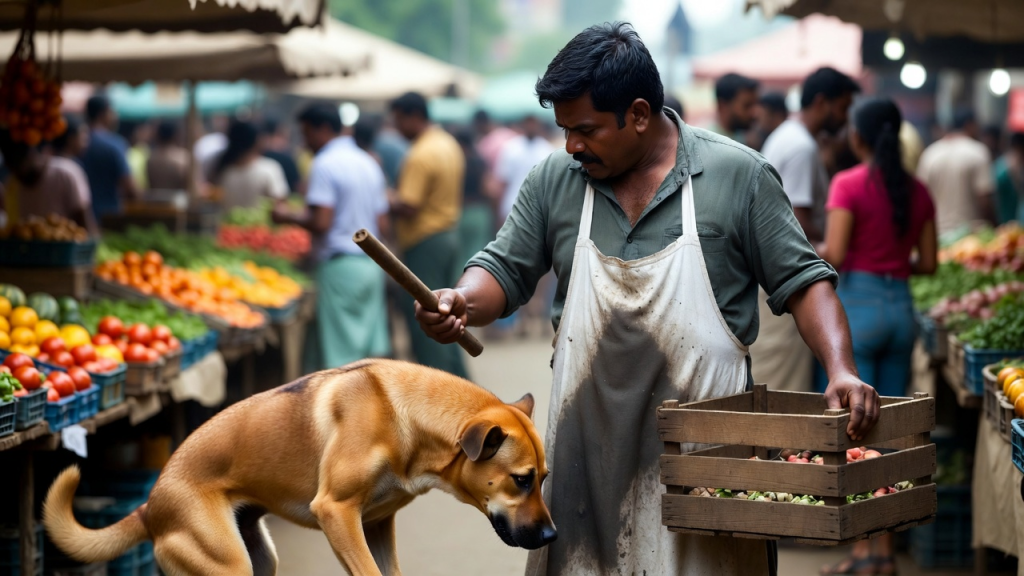
The wooden crate came down hard across the dog’s ribs before most people even turned their heads.
Lena Hart was counting change from a jar of apple butter when she heard the sound. It was a dull, heavy crack that didn’t belong in the middle of a Saturday farmers market.
She looked up and saw the three-legged dog under Mike Harlan’s produce table.
He had something in his mouth. A dinner roll, probably dropped earlier from the bakery stall. But he wasn’t eating it. He was trying to back out slow, keeping low, like he thought if he moved carefully enough nobody would notice.
Mike saw him.
Lena set the money down and stepped out from under her tent.
By the time she reached them, Mike already had the crate raised again.
“Stop!” she shouted.
The second swing landed anyway.
The dog folded. He didn’t yelp. He just curled tight around the roll like it was the only thing in the world that mattered, and tried to crawl backward on his three legs.
A few people stopped walking. A mother pulled her little girl closer. Someone’s phone came up.
Lena pushed between Mike and the dog.
“What the hell is wrong with you?”
Mike’s face was red. Sweat ran down his temple even though the morning was still cool.
“He’s been stealing since eight o’clock. Took a tomato right off the crate. Now this. I’m done with it.”
“He’s hungry,” Lena said.
She knelt down. The dog was still on the ground, breathing fast and shallow. One leg was gone at the shoulder, the stump old and healed. His fur was patchy along the ribs where old scars showed through.
She reached out slow.
He didn’t bite. He just watched her hand the way a creature watches something it has learned will eventually hurt.
“It’s okay,” she said, quieter now. “I’m not going to hurt you.”
Mike set the crate down but didn’t step back.
“Somebody needs to do something about these strays. They’re getting bold.”
A man in a John Deere cap muttered, “Back in my day we didn’t let them hang around.”
A teenager filming with his phone said nothing, just kept the camera on the dog.
Lena didn’t look at any of them.
She kept her eyes on the dog. He had dropped the roll when the crate hit him. It lay a few inches from his nose. He stared at it like he wanted it more than anything but didn’t dare take it while people were watching.
She picked it up and held it out.
He didn’t move.
She set it down again, closer to him this time, then stood up and walked back to her stall without looking at Mike.
The market tried to go back to normal.
But it didn’t.
Mrs. Ellison came over a few minutes later, leaning on her cane, and bought her usual two jars of blackberry jam even though she already had three at home.
“That was a terrible thing to watch,” she said, voice low. “Mike Harlan’s got troubles, but that doesn’t give him the right.”
Lena nodded. She was still watching the spot where the dog had been.
He had moved. He was behind an old cooler near the edge of the gravel lot now, half hidden, still watching everything.
“He didn’t even try to run,” Lena said.
Mrs. Ellison followed her gaze.
“Some dogs learn early that running makes it worse.”
Lena sold the rest of her jam on autopilot. Every time she glanced over, the dog was still there. The roll was gone. He must have taken it when nobody was looking.
By noon she couldn’t stand it anymore.
She packed up early, loaded the crates into the bed of her old Ford, and drove the truck around to the edge of the lot.
She left the tailgate down.
Then she walked over to the cooler and sat on the ground a few feet away.
The dog lifted his head.
“I’m not taking you anywhere you don’t want to go,” she said. “But I’m not leaving you here either.”
She went back to the truck and got the old flannel shirt she kept behind the seat for cold mornings. She laid it on the ground between them.
He sniffed it from a distance.
She sat on the tailgate and waited.
It took twenty minutes.
He came out slow, stopping every few steps to check the crowd, to check her, to check the sky like even the clouds might turn on him.
When he reached the shirt he stood on it for a long time. Then he hopped, awkward and careful, up into the bed of the truck.
Lena closed the tailgate gently.
She drove home with the windows down so he could smell the air.
Her house sat at the end of a gravel road on the edge of Willow Creek. One story, white paint peeling a little on the north side, a porch that sagged on the left. It was quiet. That was why she had bought it five years ago after her divorce. Quiet felt safe.
She backed the truck up to the porch and opened the tailgate.
The dog didn’t move.
She went inside, heated up some leftover rotisserie chicken, put it in a bowl with water, and carried it out.
She set everything on the porch boards.
Then she sat on the top step and waited again.
The dog climbed down from the truck bed like it hurt. He drank the water in long, careful laps. When he finished he looked at the chicken.
He picked up a piece in his mouth.
But instead of eating it where he stood, he carried it to the far corner of the porch, behind the old rocking chair Lena never used. He lay down there, tucked the chicken between his front paws, and watched the road.
He didn’t eat it.
He guarded it.
Lena felt something shift in her chest, something old and sharp.
She had seen that before.
When she was twelve her father’s hound had gotten into the trash. Her father had kicked the dog so hard the dog couldn’t stand up for two days. Lena had hidden in her closet with her hands over her ears and done nothing.
She rubbed the scar on the back of her left hand without thinking. The one from the glass she landed on when her father shoved her out of the way.
She went inside and came back with a blanket.
She didn’t try to touch the dog.
She just spread the blanket on the porch floor a few feet from where he lay and sat down on it.
The sun moved across the yard.
The dog ate a little of the chicken when he thought she wasn’t looking. Then he hid the rest again, under the edge of the blanket this time.
Lena stayed where she was.
Around dusk she went inside and got her laptop.
She searched for three-legged dog care and then, after a minute, typed something else.
“Why would a dog hide food instead of eating it”
The answers came back fast. Trauma. Resource guarding from starvation. Learned behavior from being punished for eating.
She closed the laptop.
Outside, the dog had finally put his head down. One eye stayed half open.
Lena sat on the floor near the door so she could see him through the screen.
She thought about tomorrow.
She would go back to the market. She would ask around. Someone had to know where a three-legged dog with whip scars had come from.
Because a dog didn’t learn to take a beating without fighting back unless someone had spent years teaching him that fighting back only made it worse.
And Lena had already spent too many years staying quiet when she should have spoken.
She wasn’t going to do it again.
Not this time.
Not with this dog.
She pulled the blanket closer around her shoulders and stayed on the floor until the crickets got loud and the dog’s breathing evened out into something close to sleep.
In the morning she would find out who had broken him.
And then she would decide what to do about it.
Chapter 2
Lena woke before the sun touched the windows.
She lay still in the dark and listened. The house was quiet the way it always was, but there was a new sound underneath it now — soft, steady breathing coming from the porch. In and out. Careful. Like even sleep had to be done quietly.
She got up, made coffee in the old percolator that hissed and popped, and carried the bowl of kibble she had bought at the gas station out to the porch steps. The morning air was cool and smelled like wet grass and the last of the summer honeysuckle along the fence.
Blue was already awake.
He lay in the same spot behind the rocking chair where he had spent the night, his body curled tight around nothing. The chicken from yesterday was gone. She knew he had hidden what he didn’t eat.
She set the bowl down between them and sat on the top step, farther back than yesterday.
“You don’t have to hide it,” she said. Her voice came out low so it wouldn’t startle him. “It’s yours. All of it.”
He watched her with those cloudy eyes. Then he looked at the bowl. Then back at her.
She turned her head toward the trees like she wasn’t paying attention.
When she glanced back a minute later the bowl was half empty and he was already back in his corner, watching the road like he expected someone to come walking up it any second.
Progress, she told herself. Small, but it was something.
She took him to Dr. Rachel Kim’s clinic that morning.
The place smelled like every vet clinic she had ever been in — antiseptic, wet fur, and the faint sweetness of the treats they kept in a jar by the front desk. A golden retriever with a plastic cone sat across the waiting room and thumped its tail against the bench when it saw Blue. Blue pressed himself hard against Lena’s calf and stayed there.
Dr. Kim came out wearing blue scrubs and a tired smile. She was forty-two, black hair pulled into a knot, and she moved like someone who had seen too much and still showed up anyway.
She talked to Blue the whole time she examined him, her hands slow and steady.
“Three legs and still getting around,” she said softly. “You’re a tough one, aren’t you?”
When she parted the fur along his spine and sides, she went quiet for a long moment.
Lena saw what she was looking at.
Thin lines, some silver with age, some still pink. They ran in parallel across his back and down his hindquarters. Whip marks. Old ones layered over older ones. The kind that never quite faded all the way.
Dr. Kim’s mouth tightened at the corners.
“This dog has been hit,” she said. “Repeatedly. Over years. These here—” she traced a line with one gloved finger without touching the skin, “—look like they came from a belt or a thin switch. The missing leg is an old injury. Healed wrong. Probably a trap or a fight he lost a long time ago. Teeth are worn down. I’d put him at eight or nine years old. Malnourished but stabilizing.”
Lena felt the coffee she had drunk on the way over turn sour in her stomach.
“Who does this to a dog for years?” she asked.
Dr. Kim stripped off her gloves and sat on the rolling stool.
“People who were broken themselves and never learned another way. Or people who think animals don’t feel things the way we do. I’ve seen both. Neither one is an excuse.”
She gave Blue the shots he needed, checked his heart and lungs, and pronounced him otherwise sound for a dog who had lived the life he had lived.
“You planning on fostering him?” she asked while she wrote up the chart.
Lena nodded before she had finished thinking it through.
“For now. Until I know where he came from and whether anybody’s looking for him.”
Dr. Kim gave her a long look over the top of her glasses.
“Sometimes the place they belong is with the first person who bothered to see what was done to them.”
Lena paid the bill she couldn’t really afford and drove home with Blue in the passenger seat. He sat upright the whole way, ears pricked, watching everything like he was memorizing the route in case he had to find his way back alone.
She stopped at the closed farmers market anyway.
It was Sunday and the lot was empty except for a few cars parked near the church down the street where the bake sale was happening. Mrs. Ellison was behind a folding table selling peach pies and looking like she had been there since dawn.
“I put a post up last night,” Lena said after she bought a pie she didn’t need. “About the dog. Somebody commented he might be from the old Carver place out on County Road 12. Roy Carver.”
Mrs. Ellison’s hands stilled on the pie box.
“Roy Carver was a mean drunk,” she said after a moment. “Died five or six years back. Bank took the farm. People around here knew he kept dogs chained up and beat them if they barked too much or ate too fast. Animal control got called once or twice but nothing ever came of it. Small town. Folks mind their own business until they can’t.”
Lena felt the scar on the back of her hand itch.
“Anybody ever try to help the dogs?”
Mrs. Ellison shook her head.
“Roy’s boy Dale still lives in town. Works odd jobs at the feed store when he feels like it. Mean like his daddy but keeps it quieter. You be careful poking around that old place, Lena. Some wounds don’t like to be looked at.”
Lena thanked her and drove out to County Road 12 anyway.
The road got narrower the farther she went. Weeds grew up through the cracks in the asphalt. The mailbox at the end of the long driveway had rusted so badly the name was gone. The house itself sat crooked on its foundation, windows broken, one side of the porch collapsed like something heavy had fallen through it years ago.
She parked and walked up the gravel drive.
The barn was still standing, though the roof sagged in the middle. Inside it smelled of old hay, rust, and something sharp and sour that might have been urine or fear left behind in the wood.
In the back corner three makeshift dog runs had been built against the wall. Chain-link panels wired to wooden posts. Rusted chains bolted into the studs with heavy lag screws. One metal bowl still sat in the dirt with dried bits of something stuck to the bottom.
Lena picked up one of the chains. It was heavy in her hand. The links were worn smooth in places where something had pulled against them for a long time.
She imagined a dog chained here day after day, year after year. Beaten when it tried to eat. Beaten when it barked. Learning that the only way to keep anything was to hide it where no one could see.
She thought of her father’s voice in the backyard the day he kicked Duke so hard the old hound couldn’t get up. She had been twelve. She had stood at the kitchen window with her hands over her mouth and done nothing. Later that night she had packed a bag for college two years early and never really come home again until the funeral.
Her fingers found the scar on her hand without her telling them to.
She walked deeper into the barn and saw it hanging on a nail driven into a post.
A faded leather collar, almost rotted through. The metal tag was still attached, bent and dull but the letters were still there if you looked close.
BLUE
Just the name. No address. No phone number. Like whoever put it on him didn’t want anyone calling to ask questions.
Lena took the collar down. The leather was stiff and cracked. She held it for a long time before she put it in her jacket pocket.
When she got home Blue was on the porch again, lying in the shade of the rocking chair.
She sat on the floor a few feet away and took the collar out.
He smelled it from where he was.
Then he backed up until his hindquarters hit the wall. His ears went flat. A low sound came out of him — not quite a growl, more like something old and hurt being pulled up from deep inside.
Lena set the collar on the floor between them and moved back.
“It’s okay,” she said. “He’s gone. Roy Carver is gone. He can’t hurt you anymore.”
Blue didn’t come closer for a long time.
That night she sat on the porch with a blanket wrapped around her shoulders and the collar beside her. The wind moved through the trees at the edge of the yard and made the old boards creak.
Blue came out of his corner after the light was gone.
He lay down a foot away from her this time. Not touching. But the space between them was smaller than it had been the night before.
Lena didn’t reach for him.
She just sat there and let the quiet settle.
Her phone buzzed against the porch floor.
Unknown number.
She opened the message.
“Mind your own business about old dogs. Some things are better left buried.”
She read it twice.
Then she deleted it.
Blue shifted in his sleep until his back rested against her leg. Warm. Heavy. Real.
She didn’t move her leg.
For the first time in years the quiet of the house behind her didn’t feel like something missing. It felt like something that might be starting to fill up.
But she knew the messages wouldn’t stop.
And she knew that whoever sent that text — Dale Carver or someone who still thought Roy’s way of doing things was fine — wasn’t going to like what she did next.
She was going to find every person who had looked away while Blue was being broken.
She was going to make sure none of them ever got the chance to do it again.
Blue sighed in his sleep, a small tired sound that went straight through her.
Lena put her hand on his back, right over one of the old silver scars, and left it there.
He didn’t flinch.
She stayed that way until the crickets quieted and the sky started to go gray in the east.
In the morning she would take the collar to the sheriff’s office.
She would show them what Roy Carver had done and what nobody had stopped.
And if they told her it was just a dog and too many years ago, she would keep going anyway.
Because Blue had spent too many years being invisible.
And Lena had spent too many years pretending she didn’t see.
She wasn’t going to do either one anymore.
Blue’s breathing evened out against her leg.
She closed her eyes and let herself rest for the first time since the crate had come down at the market.
Tomorrow the real work would start.
And she already knew it was going to cost her more than money.
Chapter 3
Lena stood in the Willow Creek Sheriff’s Office at eight-thirty the next morning with the rusted collar in one hand and printed photos of Blue’s scars in the other. The fluorescent lights buzzed overhead. A fan in the corner moved hot air around without cooling anything.
Deputy Carl Wilkins looked at the collar like it was something she had found in a ditch.
“Roy Carver’s been dead five years,” he said. His voice was the same one he used on speeders and kids tagging the water tower. “Bank took the place. Dogs are long gone. What exactly do you want me to do with this, ma’am?”
Lena set the collar on his desk. The tag with BLUE still faced up.
“I want you to look at what was done to him. The vet said these marks are from years of beatings. Somebody needs to answer for that.”
Carl leaned back in his chair. The springs creaked.
“Answer to who? Roy’s in the ground. His boy Dale pays his taxes and stays out of trouble mostly. That dog you got is alive and eating. Seems like the story already has an ending.”
Lena felt heat climb her neck.
“The ending is that a dog learned to hide food so he wouldn’t get whipped for eating it. The ending is nobody stopped it while it was happening.”
Carl picked up the collar, turned it over once, and set it back down.
“Sometimes the kindest thing is to let old things stay buried. You got the dog now. Take care of him. Leave the rest alone before you stir up people who don’t like being reminded.”
She took the collar back. Her hands were steady even though her chest felt tight.
“I’m not letting it stay buried.”
She walked out before he could answer.
Outside, the sun was already hard on the sidewalk. She sat in her truck for a minute with the collar on the seat beside her and tried to breathe past the anger.
Her phone rang. Her brother’s name on the screen.
She almost didn’t answer.
“Mom said you took in some stray that got beat up at the market,” he said when she picked up. No hello. “You sure you want to do that again?”
Lena closed her eyes.
“It’s not the same.”
“It’s exactly the same. You see something broken and you think fixing it will fix you. Then it costs you money and sleep and you get mad at the world when it doesn’t work out. Remember Duke?”
She remembered. Every detail. The way the old hound had looked at her from the ground after their father kicked him. The way she had turned away and gone inside.
“I remember,” she said.
“Then leave it alone this time. Some dogs and some people don’t get better. You can’t save everything.”
She hung up without answering.
When she got home Blue was on the porch, but he wasn’t in his usual corner. He was sitting at the top of the steps like he had been waiting. When she opened the truck door he stood up, balanced on his three legs, and watched her walk toward him.
She sat down beside him without touching.
“Deputy says it’s old news,” she told him. “Says I should let it go.”
Blue leaned his weight against her side, just a little. Enough that she felt the warmth through her shirt.
She put her hand on his back, over the worst of the scars, and left it there.
“I’m not letting it go.”
That afternoon she drove to the feed store on the edge of town.
Dale Carver was behind the counter stacking fifty-pound bags of dog food. He was in his late thirties, broad through the shoulders like his father had been, but he carried it with a kind of watchful stillness instead of Roy’s open anger.
He looked up when the bell over the door rang.
“Help you with something?”
Lena set the collar on the counter between them.
“I found this at the old place on County Road 12. Belonged to a dog named Blue. You know anything about him?”
Dale’s eyes flicked to the collar and back to her face. Nothing in his expression changed, but something in the air did.
“Lot of dogs been through there over the years. Hard to keep track.”
“This one had three legs and whip marks all over him. Vet says he was beaten for a long time. Somebody taught him to hide his food so he wouldn’t get hit for eating it.”
Dale wiped his hands on his jeans.
“Sounds like you already got yourself a story. Why you bringing it to me?”
“Because your father owned that farm. And people are saying he was the one who did it.”
Dale leaned forward on the counter. His voice stayed low and even.
“My father’s dead. Whatever he did or didn’t do died with him. You got a dog that’s still breathing. Be grateful for that and go home.”
Lena didn’t move.
“I’m not grateful for what was done to him. And I’m not going to pretend it didn’t happen just because it’s easier.”
Dale smiled, but it didn’t reach his eyes.
“People in this town like their quiet. You keep pushing, you might find out how much they like it.”
He went back to stacking bags like the conversation was over.
Lena took the collar and walked out.
That night she posted again on the local group. She didn’t use Blue’s name or show his face. Just the collar and a short caption: “Found this at the old Carver place. Dog that wore it is safe now. If you know anything about what happened to him, I’d like to hear it. Some things shouldn’t stay buried.”
The comments started slow, then came faster.
Most were the usual mix. “Good for you.” “Just a dog.” “Leave it alone, lady.”
Then one from a name she didn’t recognize.
“My uncle used to work for Roy Carver back in the nineties. Said the dogs were kept chained and fed just enough to stay alive. One of them lost a leg in a trap and Roy still beat it when it couldn’t pull its weight. That dog’s name was Blue. He was the last one left when the bank came.”
Another comment underneath it: “Dale still sells feed to half the county. You really want to make an enemy over a dead man’s dog?”
Lena closed the laptop.
Blue was lying on the rug near the couch now instead of the porch. He had followed her inside after dinner and stayed. When she sat on the floor he came over and lay down with his back against her leg again.
She stroked the fur between his ears.
“We’re not stopping,” she said.
He sighed and closed his eyes.
The next morning Jake Morrison showed up in his dad’s old pickup with a load of scrap lumber in the back.
“I saw your post,” he said, already unloading boards. “Figured if you’re keeping him you might want a proper run so nobody can mess with him. I got some chain link left over from when we fenced our place.”
Lena helped him carry the wood to the side yard.
“You don’t have to do this.”
Jake shrugged. He was nineteen, all elbows and quiet determination.
“Somebody should have done something a long time ago. Might as well start now.”
They worked through the heat of the day. Blue watched from the porch, moving closer every hour until he was lying in the grass ten feet from where they were hammering posts into the ground.
When they finished the basic frame Jake wiped sweat off his face and looked at Blue.
“He’s starting to trust you.”
Lena nodded.
“Some days more than others.”
Jake hesitated.
“My mom said Dale Carver came into the hardware store yesterday asking who was asking questions about his dad’s dogs. Said he didn’t look happy.”
Lena kept her hands busy coiling extra wire.
“I’m not surprised.”
“You want me to stick around tonight? Or call somebody?”
She shook her head.
“I’ll be fine. Blue and I have been fine so far.”
Jake left before dark. The new run stood solid in the side yard, chain link shining in the last light.
Lena made dinner and left Blue’s bowl on the porch like always. He ate half of it while she was still outside, then carried the rest to his corner and lay down with it between his paws.
She didn’t push him.
After dark she sat on the steps with the collar in her lap.
Her phone buzzed.
Unknown number again.
“You were told to leave it alone. Next time it won’t be a text.”
She read it once, then deleted it like the first one.
Blue came out of his corner and lay down against her leg without being asked.
She put her hand on his back and felt the steady rise and fall of his breathing.
For a long time neither of them moved.
Inside the house the lights were off. The quiet felt different now. Not empty. Not safe exactly. But full of something that mattered more than safety.
Lena thought about her brother’s words. About Deputy Carl telling her to let it go. About Dale’s flat voice behind the counter.
She thought about the twelve-year-old girl who had stood at a kitchen window and done nothing while an old dog suffered.
That girl had grown up and built a life where nobody could reach her. Quiet job. Quiet house. Quiet heart.
Blue had broken all of it open with one look and a piece of hidden food.
She wasn’t going to close it again.
Tomorrow she would call the woman who had commented about her uncle. She would ask for more names, more details, anything that could be written down and shown to people who didn’t want to see.
If the town wanted quiet, they could have it after the truth was out.
Blue shifted closer until his head rested on her foot.
She left it there.
Sometime after midnight a car drove slow down the gravel road in front of the house. It didn’t stop. Just rolled past with its lights off.
Blue lifted his head and watched it until the sound faded.
Lena stayed where she was.
She wasn’t going anywhere.
And neither was the truth.
Chapter 4
Lena woke on Saturday morning and knew what she had to do.
She loaded her jam jars into the truck the same way she had every weekend for five years. But this time she also packed the rusted collar, the printed photos of Blue’s scars, and a piece of poster board she had written on the night before with a black marker.
She drove to the farmers market before the sun was fully up.
When she set up her stall she didn’t just arrange the jars. She placed the collar on the table in front of them. She taped the photos along the edge of the tablecloth. And she stood the poster board where anyone walking by could read it.
THIS IS WHAT SILENCE LOOKS LIKE. BLUE SURVIVED IT. OTHERS DIDN’T.
People started arriving. The usual Saturday crowd. Families. Tourists. Regulars who had bought her apple butter for years.
Some stopped and stared at the photos. Some read the sign and kept walking. A few came closer and asked questions in low voices.
Lena answered every one of them.
By mid-morning a small crowd had gathered around her stall. Mrs. Ellison was there with her cane and a plate of cookies she wasn’t selling. Jake stood off to the side with his hands in his pockets, watching. Mike Harlan was at his produce stall two rows over, but he kept glancing over.
Blue lay on a blanket under Lena’s table. He had come willingly when she loaded the truck. He had even eaten a little of his breakfast while she was still watching.
Around ten o’clock Dale Carver walked into the market with two other men.
He stopped when he saw the sign.
For a long minute he just stood there. Then he walked straight to Lena’s stall.
“You need to take that down,” he said. His voice was quiet but it carried.
Lena didn’t touch the sign.
“I don’t think I do.”
Dale stepped closer. One of the men with him stayed back. The other moved like he might come around the side of the table.
“That dog was my father’s business. Not yours. Not this town’s. You’re stirring up things that don’t need stirring.”
Lena felt Blue shift under the table. She reached down and rested her hand on his back without looking.
“Blue is my business now. And what was done to him is everybody’s business.”
Dale’s face tightened.
“You don’t know what you’re talking about.”
“I know what the vet saw. I know what was left chained in that barn. I know a dog learned to hide his food because eating it in the open got him beaten. That didn’t happen by accident.”
A woman in the crowd spoke up.
“My kids used to be scared to walk past that farm. Everybody knew Roy Carver was mean to his dogs.”
Another voice, an older man: “I bought hay from him once. Saw a dog chained up with no water. I told myself it wasn’t my problem.”
Dale looked around. More people had stopped. Some were nodding. Some were looking at their shoes.
Mike Harlan left his stall and walked over. He stopped beside Jake.
“I knew,” Mike said. His voice was rough. “I knew Roy beat those dogs. I saw it once when I was delivering crates. I told myself it wasn’t my business. I needed the cheap produce he sold me. My wife was sick. I had bills. So I looked away.”
He looked at Lena.
“I looked away the same way I looked away when that crate came down on this dog last week. I was wrong both times.”
Dale turned on him.
“You don’t get to rewrite history because some woman shows up with pictures.”
“I’m not rewriting anything,” Mike said. “I’m just saying it out loud for once.”
The crowd had grown. Deputy Carl’s cruiser pulled into the lot and parked at the edge. He got out but didn’t come closer yet.
Dale took one more step toward Lena’s table.
“Take the sign down. Now.”
Blue moved.
He came out from under the table on his three legs and stood between Lena and Dale. He didn’t growl. He didn’t bare his teeth. He just stood there, head low, body tight, the way he had stood the day the crate came down.
But this time he didn’t try to crawl away.
Lena put her hand on his back again.
Dale looked at the dog. For a second something flickered across his face that might have been shame or memory or both.
Then it was gone.
He turned and walked away without another word. The two men followed him.
The crowd stayed.
Mrs. Ellison was the first to speak.
“I bought jam from Roy’s wife for years. I heard the dogs at night sometimes. I never asked. I should have asked.”
Other people started talking. Not all at once. Quiet stories. A man who had worked for Roy one summer. A woman whose father had looked the other way when a neighbor complained. A teenager who said his grandfather still defended Roy and called the dogs “just animals.”
Lena stood behind her table and listened.
She didn’t feel triumphant. She felt tired and something else she couldn’t name yet.
Deputy Carl finally walked over. He looked at the sign, at the collar, at Blue.
“You got a lot of people talking,” he said.
“That was the point.”
He nodded once.
“I’ll take statements if anybody wants to give them. Can’t promise much after all this time. But I’ll take them.”
He walked back to his cruiser and leaned against it with a notebook.
People stayed and talked for another hour. Some left. Some came back with others. The market went on around them, but the air felt different.
By early afternoon the crowd had thinned. Lena started packing up.
Mike came over while she was loading crates.
“I’m sorry,” he said. “For the crate. For all of it. I don’t expect you to forgive me. But I wanted to say it.”
Lena looked at him.
“I don’t know if I can forgive it yet. But I believe you’re sorry.”
He nodded.
“If you need help with anything for the dog — food, a better fence, whatever — you let me know. No charge.”
He walked back to his stall.
Jake helped her load the last of the tables.
“You did good,” he said.
“I don’t know what I did,” Lena answered. “I just stopped being quiet.”
Blue rode home in the passenger seat again. He sat upright the whole way, ears forward, watching the road like he was making sure they were really going back to the little white house at the end of the gravel drive.
That night Lena sat on the porch steps with a blanket around her shoulders.
Blue lay beside her instead of in his corner. The new run stood empty in the side yard. He hadn’t needed it today.
She had left his food bowl on the porch boards the way she always did.
He ate from it while she watched.
All of it. No hiding. No carrying pieces away to guard. He finished what was in the bowl, then lay down and put his head on her foot.
Lena let the tears come. She didn’t try to stop them.
She thought about Duke. About the twelve-year-old girl at the kitchen window. About the years she had spent making sure nobody could reach her.
She thought about the collar on the table inside. About Roy Carver dead in the ground and Dale Carver walking away from the market with his head down.
She thought about every person who had spoken today. Every person who had finally said the words they had kept inside.
Blue sighed against her foot.
Lena reached down and stroked the fur between his ears.
“You don’t have to hide anymore,” she said. “Neither do I.”
The crickets started up in the trees. The sky went dark blue and then black.
Somewhere down the road a car passed, but it didn’t slow down.
Lena stayed on the porch until the stars came out and Blue’s breathing turned deep and even.
She had come to the market that morning with a sign and a dog and a story she couldn’t keep quiet anymore.
She was going home with the same dog, the same scars on both of them, and a kind of quiet that finally felt like peace instead of hiding.
Blue never had to guard his food again.
And Lena never had to guard her silence.
She sat there with her hand on his back until the night grew cold and the first light touched the edge of the trees.
Then she stood up, and Blue stood up with her, and they went inside together.