👁 10 views
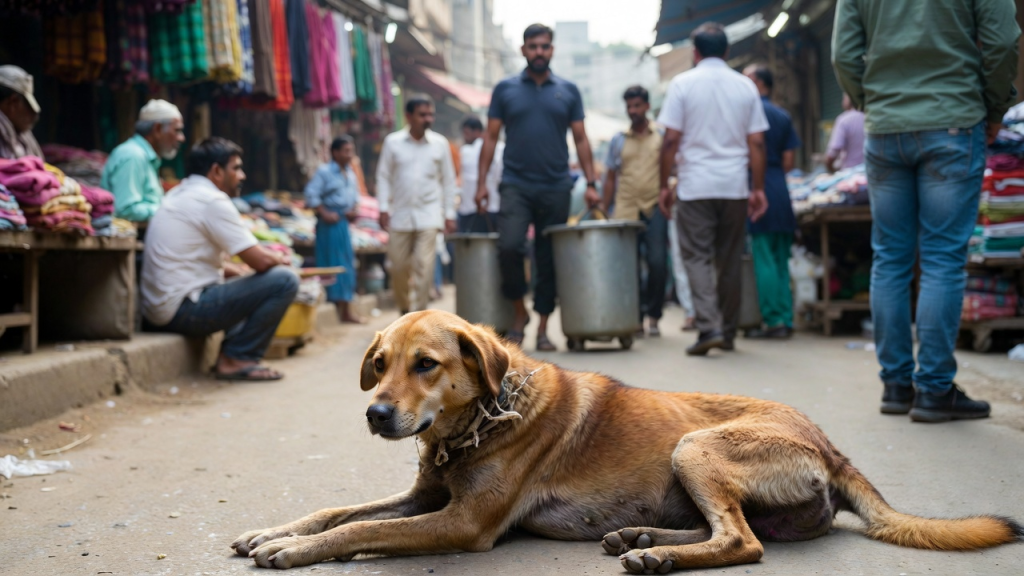
I was standing at Frank Rossi’s bread stall with a basket of strawberries in one hand when the shouting started.
The Saturday farmers’ market in Cedar Falls was the way it always was in June — kids sticky from honey sticks, old men arguing over tomato prices, the smell of fresh sourdough mixing with diesel from the trucks parked along Main Street.
Then Frank’s voice cut through everything.
“Get the hell out of here, you worthless mutt!”
People turned. Phones came up. A little girl pointed until her mother pulled her hand down.
The dog was already backing away from the table, a torn loaf clamped in his jaws. He was medium-sized, brown and white, the kind of dog nobody claims. One back leg dragged when he moved. His fur was matted along the ribs. He looked like he had been running on empty for a long time.
Frank came around the table fast. His face was red the way it got when the arthritis in his hands was bad and the stall wasn’t making enough to cover the rent on the little house he still couldn’t sell after his wife died.
The dog tried to turn. The bad leg slowed him down.
Frank’s boot caught him in the side.
The sound the dog made wasn’t a growl. It was a yelp — sharp, surprised, like he had expected it but it still hurt worse than he remembered.
The bread flew out of his mouth and landed in the dirt between two stalls.
I dropped my strawberries.
“Frank, stop!” I pushed through the crowd. My name is Jenna Walsh. I work animal control for the county and volunteer at the no-kill shelter on weekends. I have seen enough hurt animals that I should have been numb by now. I wasn’t.
Frank didn’t look at me. “This ain’t the first time, Jenna. Last week he took a whole cherry pie. Week before that he cleaned out three dinner rolls. I’m trying to keep this stall alive. I can’t feed every stray in town.”
The dog scrambled to his feet. He didn’t bare his teeth. He just looked at the bread on the ground like it was the only thing standing between him and something worse than a kick.
Frank raised his foot again.
I stepped between them.
“Look at his leg,” I said. My voice came out steadier than I felt. “He’s hurt. He’s not trying to fight you.”
Frank’s shoulders dropped for a second. I saw the photo of his late wife taped to the inside of the cash box. Maria had been gone eight months. The stall was all he had left of the mornings they used to share. I knew that. Half the town knew that. Knowing didn’t make the boot any softer.
Advertisement
Promoted Content

The 9 Kardashian Bombshells Still Sparking Buzz Today
185
“He’s a thief,” Frank said, quieter now. “And I’m tired of being the one everybody expects to understand.”
The dog moved fast then. He snatched the dirty loaf and limped hard toward the narrow alley between the old feed store and the post office. People stepped back like he might bite. Nobody followed him.
I should have stayed. I had enough waiting for me — the shelter was full again, my daughter Lily hadn’t spoken to me in three days except to ask for money I didn’t have, and my ex had called twice about changing custody again. I was supposed to be off today. I was supposed to buy vegetables and pretend my life was simple.
But the way the dog looked back over his shoulder before he disappeared into the alley made my feet move before I could talk myself out of it.
I left the strawberries where they fell.
The alley smelled like old grease and spoiled lettuce from the restaurant next door. Trash bins lined the right side, lids broken, bags spilling out because the hauler was late again. Cardboard boxes were stacked behind the Chinese place, soggy from the rain that came through last night.
The dog was halfway down. He wasn’t running anymore. He was limping toward the last green bin with the broken lid. He still had the bread in his mouth.
I slowed down. “Hey, buddy,” I said, keeping my voice low. “It’s okay. I’m not here to hurt you.”
He stopped. Turned his head. One torn ear twitched. His eyes met mine — brown, too smart, too tired. He held my gaze longer than a stray usually does.
Then he dropped the bread.
Not because he was finished with it. Because he needed his mouth free.
He hobbled the last few steps to the pile of flattened cardboard and old newspapers under the bin. He pawed at it once, twice. A sound came from underneath — small, high, like wind through a cracked window but alive.
Whimpers.
Three of them.
I knelt down, heart beating hard in my throat. I moved the cardboard slowly.
There they were.
Three puppies. No more than four or five weeks old. One black, one brown, one spotted like the dog standing over them. Their ribs showed through skin that was stretched too tight. Their eyes were crusted. They were tangled together in a nest made of an old flannel shirt someone had thrown away. The smell of them — sour milk and waste and the sharp scent of hunger — hit me like a fist to the chest.
The dog — their father, or at least the one who had refused to leave them — stood guard. His tail was tucked. He didn’t growl. He just watched me the way someone watches the only person who might still be able to help.
I reached out and touched the smallest one’s head. It was cold. Too cold for a June morning.
The dog nudged the loaf of bread toward the puppies with his nose. Like he was showing me what he had risked everything for. What he had let himself get kicked for.
I sat back on my heels in that dirty alley while the market kept going twenty feet away like the world hadn’t just tilted.
This dog hadn’t been stealing bread for himself.
He had been trying to keep three lives from ending in the dark under a trash bin.
And nobody else had followed him.
Only me.
I pulled out my phone with hands that wouldn’t stay steady. I called the shelter. Told them I needed a crate, puppy formula, heating pads, and someone who could meet me behind the market in ten minutes. While I waited I took off my light jacket and laid it over the puppies as gently as I could. The dog lay down beside them, close enough that his body could share what little warmth he still had.
He looked at me again. This time his tail moved. Just once. A single tired thump against the concrete.
“You did good,” I whispered. My throat felt tight. “You did real good, buddy.”
The market noise was still there — laughter, car doors, someone selling kettle corn — but it felt far away. All I could hear was the faint breathing of three starving puppies and the quiet, ragged breaths of the dog who had refused to give up on them.
For the first time in months I didn’t feel tired.
I felt like I was exactly where I was supposed to be.
But as I heard the shelter van turn into the alley and, somewhere in the distance, the low sound of a siren — someone must have called the police about an “aggressive dog” — I realized the hardest part wasn’t finding them.
It was going to be keeping them alive long enough for the town that had kicked their father to understand what he had really been fighting for.
Chapter 2
The siren was still a few blocks away when the shelter van pulled into the alley.
Tyler, the new vet tech, jumped out first. He was twenty-four, lanky, with a faded Paws & Hearts hoodie and the kind of tired eyes that came from too many nights bottle-feeding kittens. He took one look at the pile under my jacket and said, “Jesus, Jenna.”
“Three puppies,” I told him. My voice sounded steadier than I felt. “Maybe four weeks. The big one’s their dad. He’s been feeding them.”
Tyler knelt beside me. The dog — I was already thinking of him as their father — didn’t move. He just watched Tyler’s hands the way he had watched mine, like he was measuring whether this new person was worth the risk.
“Easy, buddy,” Tyler said. He had a calm way with scared animals that I envied. “We’re not taking them from you. We’re just trying to keep everybody breathing.”
I helped slide the puppies into a small carrier lined with towels. They were so light it felt wrong. The spotted one whimpered when I lifted her but didn’t have the strength to struggle. The black one didn’t make a sound at all. I checked his gums the way I’d been taught — pale, almost white. That wasn’t good.
The dog stood up when we moved his babies. His bad leg buckled once, but he caught himself. He followed the carrier to the van without being asked, like he had already decided we were his only option left.
Deputy Cole Ramirez pulled up just as we were loading the last towel. He was forty-two, built like he still did push-ups every morning, and he had the slow, careful way of moving that came from seeing too many things go wrong in small towns. His cruiser idled behind the van. The lights weren’t flashing. That was something.
“Jenna,” he said. Not unfriendly. Just tired. “Got a call about an aggressive dog at the market. Frank Rossi says it bit him.”
“It didn’t bite anyone,” I said. I kept my hands visible, the way you do with cops even when you know them. “It took a loaf of bread because it was starving. Frank kicked it. I saw it.”
Cole looked past me at the dog climbing into the van on its own. The animal paused at the door, glanced back at the alley like he was making sure he hadn’t left anything behind, then jumped. The van rocked a little when he landed.
“Frank’s got a bruise on his shin and half the market filming it,” Cole said. “Some kid posted it already. Caption says ‘crazy dog attacks bread vendor.’”
I felt something cold settle in my stomach. “You know Frank. He’s been mean since Maria died. That dog didn’t attack anybody.”
Cole rubbed the back of his neck. “I’m not here to argue the video, Jenna. I’m here because people are scared and Frank’s a taxpayer. You taking them to the shelter?”
“Emergency vet first,” Tyler said from inside the van. “These little ones aren’t gonna make it without fluids.”
Cole nodded once. He looked at the dog again. Something in his face softened for half a second. “That leg looks old. Probably never set right.”
“Probably never had the chance,” I said.
He didn’t answer. Just touched the brim of his hat like he used to when Maria was still alive and running the church bake sales. Then he got back in his cruiser and drove away without turning on the lights.
Tyler closed the van doors. “You riding with us?”
“I’ll follow in my truck,” I said. “I need to call Maggie and tell her we’re coming in hot.”
The shelter was on the edge of town, a low brick building that used to be a feed store. The sign still said “Paws & Hearts Animal Rescue” in faded blue letters. Inside it smelled like disinfectant and wet dog and the particular kind of hope that comes when you’re running on donations and prayers.
Maggie Ellison met us at the back door. She was fifty-eight, short, with steel-gray hair she cut herself and the kind of voice that could calm a room full of barking dogs or scare a county commissioner into approving an extra thousand dollars for vaccines. She took one look at the carrier and said, “How bad?”
“Bad,” I told her. “Three puppies, maybe four weeks. Dehydrated, malnourished. One’s barely responsive. The dad’s got an old leg injury and he’s skin and bones too.”
We moved fast. The exam room was already prepped because Tyler had radioed ahead. Dr. Patel, the part-time vet who drove in from the next county twice a week, was waiting with fluids and a heating pad. She was quiet and precise and didn’t waste words.
While they worked on the puppies I stayed with the dog. We put him in a run with a clean blanket and a bowl of kibble soaked in warm water. He didn’t touch the food. He just stood at the gate watching the door to the exam room like he could will his babies to be okay through sheer stubbornness.
I sat on the floor outside the run. My legs were shaking now that the adrenaline was wearing off. I pulled out my phone and texted Lily: Got held up at work. Might be late. There’s lasagna in the fridge.
She didn’t answer. She rarely did anymore.
Maggie came out of the exam room wiping her hands on a towel. “Two of them are holding their own for now. The little black one’s touch and go. We’ve got him on a warming blanket and we’re pushing fluids slow. If he makes it through the night we might have a chance.”
“And the dad?” I asked.
“Old fracture in the back leg, healed wrong. Probably hit by a car six months ago or more. He’s got scars on his muzzle that look like he’s been in fights or been kicked before. No microchip. No collar. He’s been on his own a while.”
I looked through the gate at him. He was lying down now, head on his paws, but his eyes were still open. Watching.
“He led me to them,” I said. “Straight to the trash bins. He dropped the bread so he could show me where they were.”
Maggie was quiet for a long moment. “You know we’re at capacity, Jenna. We’ve got two litters of kittens in the kitten room and the big dog kennels are full. If these puppies pull through we’re going to need fosters by tomorrow night.”
“I know.”
She studied me the way she studied every volunteer who started showing up with that particular look in their eyes. “You can’t take them home again. Last time you fostered the three husky mixes your daughter didn’t speak to you for a week.”
“Lily’s sixteen. She doesn’t speak to me about a lot of things.”
“Still.” Maggie’s voice was gentle but firm. “You’ve got to set some boundaries or you’re going to burn out. And when you burn out, the animals lose the one person who fights for them.”
I didn’t answer. Because she was right and we both knew it.
Tyler came out a few minutes later. “Puppies are stable for the moment. Dad’s next for a full exam if you want to help hold him.”
The dog let us examine him. He flinched when we touched the bad leg but didn’t snap. When Dr. Patel cleaned a small cut on his shoulder he turned his head and licked her wrist once, like he was saying thank you in the only language he had left.
“He’s somebody’s dog,” she said quietly. “Or he was. See the way he watches every door? He’s used to people. Just not used to kind ones lately.”
I thought about the way he had looked back at me in the alley. Not begging. Asking.
We got him settled in a run next to the puppies’ temporary incubator setup. I sat with him for a while after everyone else had gone back to their tasks. The shelter was quiet except for the low hum of the fluorescent lights and the occasional bark from the other dogs who knew something new had arrived.
I reached through the bars and touched the top of his head. He didn’t pull away.
“You did everything you could,” I told him. “You kept them alive. That’s more than most people would have done.”
His tail thumped once against the blanket. The same tired thump he had given me in the alley.
My phone buzzed. Lily.
Saw the video. People are saying you took a dangerous dog home. Is that true?
I stared at the screen. The video. Of course someone had filmed it. Frank kicking the dog. Me stepping in. The dog running. Probably me following him too.
I typed back: He’s not dangerous. He was just hungry. I’m at the shelter.
Three dots appeared, then disappeared. Then: Whatever. I’m staying at Emma’s tonight. Don’t wait up.
I put the phone face down on the concrete floor. The old familiar ache started in my chest — the one that had been there since Lily was twelve and started asking why her dad never came to her school plays, why I always smelled like kennel cleaner instead of perfume, why we couldn’t just be normal like everyone else.
I had tried to be normal. After the divorce I got the apartment above the laundromat because it was cheap and close to the shelter. I stopped fostering for six months and tried to cook real dinners and ask about her day. But the animals kept coming. They always did. And every time I chose them, I watched another piece of my daughter pull away.
The dog in the run lifted his head. He was watching me the way he had watched Tyler — measuring.
“I’m not leaving you,” I said out loud. “Not tonight.”
He put his head back down. But he didn’t close his eyes.
Around eight o’clock Maggie came back with two cups of coffee from the gas station down the road. She handed me one and sat on the floor beside me like we were just two tired women who had run out of chairs.
“Frank called,” she said.
I almost spilled the coffee. “What did he want?”
“Said he feels bad. Said the dog looked at him before it ran and he hasn’t been able to stop thinking about it. He’s bringing over some day-old bread in the morning. For the puppies.”
I didn’t know what to say to that. Frank Rossi had kicked a starving dog in front of half the town. Now he wanted to bring bread.
“People are complicated,” Maggie said. “Grief makes them mean. Sometimes it makes them remember who they used to be.”
I thought about the photo taped inside his cash box. Maria smiling in a red apron, flour on her cheek.
“He still kicked him,” I said.
“Yes,” Maggie answered. “And tomorrow he’s bringing bread. Both things can be true.”
We sat in silence for a while. The dog in the run had finally closed his eyes. His breathing was deep and even for the first time since I’d met him.
“I’m taking them home,” I said.
Maggie didn’t argue right away. She just looked at me over the rim of her coffee cup.
“The black puppy needs round-the-clock care,” I said. “If I leave him here he might not make it. The other two need to stay warm and fed every two hours. I can do that at the apartment. I’ve got the whelping box from last time. I’ll set it up in the bathroom.”
“And Lily?”
I swallowed. “Lily’s staying at Emma’s tonight. She’ll come around. She always does.”
Maggie was quiet for a long time. Then she said, “You know you can’t save every broken thing, Jenna. Not even the ones that look at you like you’re the last good person on earth.”
“I’m not trying to save every broken thing,” I said. “I’m trying to save these three. And him.”
She stood up slowly, knees cracking. “All right. But if that black puppy crashes, you call me. Don’t try to do it alone.”
“I won’t.”
She left me there with the dog and the quiet. I finished my coffee and went to the supply closet for a carrier, formula, bottles, and the old heating pad I kept in my truck for emergencies. When I came back the dog was standing at the gate again. He knew something was happening.
“We’re going home,” I told him. “All of us.”
He didn’t wag. He just waited while I opened the gate and clipped a leash to the old collar he’d been wearing when I found him. It was frayed and faded, the kind of collar a dog wears when nobody has replaced it in a long time.
I loaded the puppies first, then opened the passenger door of my old Ford pickup. The dog jumped in without being asked. He sat on the seat like he had done it before, in another life, with another person. He looked out the windshield at the dark road ahead like he was ready for whatever came next.
Advertisement
Promoted Content

Is Your Body Giving You Away? 6 Ways It Reacts in Arguments
540
I drove slow. The town was quiet. Most of the lights were off in the little houses along Main Street. I passed the market square. Frank’s stall was empty now, the tables folded, the awning rolled up. In the dark it looked smaller than it had that morning.
My apartment was above the Speedy Wash laundromat on the corner of Elm and Third. The stairs creaked. The bathroom was small. But it was warm and it was mine.
I set up the whelping box in the bathtub the way I had a dozen times before. Clean towels. Heating pad on low. Bottles of formula warming in a bowl of hot water. The two stronger puppies took the bottle right away, tiny tails wagging even though they were still weak. The black one was slower. I had to coax him, drop formula on his tongue, wait for him to swallow. His breathing was shallow. Every few minutes I checked to make sure his chest was still moving.
The dog lay on the bath mat beside the tub. He didn’t try to get in. He just watched. Every time one of the puppies made a sound he lifted his head. When the black one finally took a full bottle and fell asleep, the dog’s tail thumped once against the floor.
I sat on the closed toilet lid and watched them all. My back hurt. My eyes burned. I hadn’t eaten since the half a granola bar I’d grabbed that morning. But for the first time in a long time the apartment didn’t feel empty.
My phone buzzed again. Lily.
Dad says if you’re fostering again he’s going to file for full custody. He saw the video too.
I closed my eyes. My ex-husband lived two states away and hadn’t seen Lily in eight months, but he still knew exactly which buttons to push when he wanted to hurt me. The threat wasn’t real — the judge had already ruled on custody twice — but it still landed like a kick to the ribs.
I typed back: We’ll talk tomorrow.
She didn’t answer.
I put the phone on silent and set it on the edge of the sink. Then I reached down and touched the dog’s head. He leaned into my hand the way tired dogs do when they’ve finally decided they don’t have to be on guard anymore.
“You need a name,” I said quietly. “Can’t keep calling you ‘the dog.’”
He didn’t offer any suggestions. Just kept his head under my palm.
“How about Scout?” I said. “You scouted out those babies and you kept them alive. Seems right.”
His tail thumped once. Maybe it was the name. Maybe it was just the warmth of my hand. Either way, I took it as yes.
I stayed in the bathroom until the sky outside the small window started to turn gray. The black puppy’s breathing evened out. The other two slept in a pile. Scout — because that was his name now — slept with one eye half-open, the way dogs do when they’re still not sure the danger has passed.
Sometime before dawn I must have dozed off with my head against the wall. When I woke up my neck was stiff and my phone had three missed calls from Maggie and one text from Tyler.
Black puppy’s vitals improved overnight. You did good getting them out of there.
I looked at the three small shapes in the box and the bigger shape on the floor beside them. Scout was awake. He was watching me the way he had in the alley — like he was still asking a question he didn’t have words for.
I answered it the only way I knew how.
“We’re not done yet,” I told him. “But we’re not alone anymore either.”
He thumped his tail once against the bath mat.
Outside, the town was waking up. Somewhere Frank Rossi was probably loading day-old bread into his truck. Somewhere Lily was probably eating cereal at Emma’s kitchen table and trying to decide if she was angrier at me or at her father. Somewhere Deputy Cole Ramirez was writing a report about a dog that may or may not have been aggressive.
And in my small bathroom above the laundromat, three starving puppies were breathing and a limping dog who had been kicked out of a crowded market was finally, finally, allowed to rest.
I stood up slowly. My legs were numb. I had a full day ahead — calls to make, a vet appointment to schedule, a daughter to try to reach, a town that was already choosing sides based on a thirty-second video.
But for right now, in this quiet moment before the sun came all the way up, I let myself believe that maybe, just maybe, following that dog into the alley had been the first right thing I had done in a long time.
Scout lifted his head and looked at me.
I looked back.
Neither of us looked away.
Chapter 3
I woke up on the bathroom floor with my neck kinked and Scout’s warm breath on my wrist.
The black puppy was still breathing. That was the first thing I checked. His little chest rose and fell under the towel, slower than the other two but steady enough that I let myself hope. The spotted one and the brown one were tangled together in the corner of the box, bellies full from the last feeding at four in the morning. Scout had stayed on the bath mat all night like a sentry who refused to clock out.
I sat up slow. My phone said 6:17 a.m. Three missed calls from Maggie, one from Tyler, and a text from Lily that just said home at 8. No emoji. No explanation. Just those four letters like she was checking a box on a list she didn’t want to be on.
I fed the puppies first. The two stronger ones latched onto the bottle like they had been waiting their whole short lives for someone to show up. The black one took longer. I had to hold him against my chest, drop formula onto his tongue one drop at a time, and wait. His eyes were still crusted but they opened a little when I whispered to him. That felt like a win.
Scout watched every second. When the black one finally swallowed and sighed, Scout’s tail thumped once against the tile.
“You’re a good dad,” I told him. “Better than some I’ve seen.”
He didn’t look proud. He just looked tired in the way that comes after you’ve been carrying something too heavy for too long.
I heard the front door at 7:52. Lily’s footsteps on the stairs were heavier than usual, like she was trying to announce herself without actually speaking. She stopped in the doorway of the bathroom and stared at the whelping box in the tub like it had personally offended her.
“Seriously?” she said. Her voice was flat. “You brought them here.”
“The black one wouldn’t have made it at the shelter,” I said. I kept my tone even. Fighting with Lily before coffee was never a good idea. “They need feeding every two hours. I couldn’t leave them.”
She crossed her arms. She was wearing the same hoodie she had left in yesterday, the one with the hole in the sleeve she refused to let me fix. Her hair was up in a messy bun that used to be my signature look when she was little and I was the one rushing her out the door for school.
“Dad texted me,” she said. “He said if you get another complaint he’s filing again. He saw the video. Everybody saw the video.”
I stood up and rinsed the bottle in the sink so I wouldn’t have to look at her right away. “The dog didn’t bite anyone, Lily. Frank kicked him. I followed him because he was hurt and starving. He led me to these three.”
“Yeah, well, the video doesn’t show that part,” she said. “It shows you yelling at Frank and then chasing a limping dog down an alley like some kind of crazy person. Emma’s mom asked if you were okay. Like you had a breakdown or something.”
I turned around. “Is that what you think? That I had a breakdown?”
She didn’t answer right away. She looked at Scout instead. He was sitting up now, ears forward, watching her the way he watched every new person — measuring whether she was safe.
“He’s big,” she said finally. “And he’s limping. People are saying he’s dangerous.”
“People say a lot of things when they only see thirty seconds of something.”
Lily’s mouth tightened. For a second I saw the little girl who used to sit on the floor with me and bottle-feed kittens on Saturday mornings, back before she decided that loving animals was embarrassing and that I was the reason her life wasn’t normal.
“I’m going to Dad’s for the weekend,” she said. “He’s picking me up after school on Friday. You can do whatever you want with the dogs. Just don’t expect me to help.”
She turned and walked out before I could answer. The front door slammed a minute later. I stood in the bathroom with three sleeping puppies and a dog who had just watched my daughter choose the other parent without a fight.
Scout made a low sound in his throat. Not a growl. More like a question.
“I know,” I said. “Me too.”
The vet clinic opened at eight. I loaded everyone into the truck — puppies in the carrier on the passenger seat, Scout in the back with the windows cracked. He rode like he had done it before, body braced against the turns, eyes on the road ahead like he was navigating by memory.
Dr. Patel was already there when we arrived. She checked the black puppy first, listened to his heart, checked his gums again.
“Better than yesterday,” she said. “Still not out of the woods. Keep him warm and keep pushing fluids. If he crashes again we might need to hospitalize him.”
I nodded. I had already decided I wasn’t leaving him at the clinic unless I had no other choice. Hospitalization cost money we didn’t have and stress the puppies didn’t need.
Scout let her examine his leg without much fuss. She took new X-rays, compared them to the ones from yesterday.
“Old break,” she confirmed. “Healed crooked. He’s probably been compensating for years. The limp isn’t going away, but with rest and maybe some pain management he could get around better than he does now.”
She looked at me over the top of her glasses. “You planning on keeping him?”
The question landed heavier than it should have. I hadn’t let myself think that far. I had been running on the next feeding, the next bottle, the next hour.
“I don’t know,” I said. “I just know I’m not letting him go back to whatever he came from.”
Dr. Patel didn’t push. She had seen too many people walk in with strays and walk out with pieces of their heart already attached.
We were almost done when my phone rang. Cole Ramirez.
“Jenna,” he said. No small talk. “Frank filed a formal complaint. Says the dog is a public safety risk and you interfered with his business. I need to come by and document the animal’s condition. Can you be at the shelter in an hour?”
I looked at Scout in the back of the truck. He was watching me through the rear window, head tilted like he could hear the tension in my voice even through the glass.
“I’ll be there,” I said.
Cole was already at the shelter when I pulled in. Maggie stood beside him with her arms crossed, the way she did when she was protecting her animals from paperwork and bad decisions. Tyler was in the back cleaning kennels and pretending not to listen.
Cole had a clipboard and a camera. He looked uncomfortable in the way good cops do when the job asks them to be something they’re not.
“Walk me through it,” he said.
I told him everything again. The bread. The kick. The alley. The puppies. The way Scout had dropped the loaf so he could show me where they were. I didn’t add any drama. I just told it straight.
Cole listened. He took photos of Scout’s leg, of the healed scars on his muzzle, of the way the dog stood with his weight shifted off the bad side. He didn’t take photos of the puppies. I think he knew that would make it harder for him to do what the complaint required.
“Frank’s under a lot of pressure,” Cole said when I finished. “Half the comments on that video are calling him an animal abuser. The other half are calling you a bleeding heart who’s going to get somebody bit. People are choosing sides in the comments like it’s a football game.”
“I’m not choosing sides,” I said. “I’m choosing the dog who didn’t let three puppies die alone under a trash bin.”
Cole looked at Scout. The dog had stayed close to my leg the whole time, not hiding, not posturing. Just present.
“I’ve got to write this up,” Cole said. “I’ll note the old injury and the condition he was in when you found him. That should help. But if Frank pushes, or if the ex pushes, it could get messy.”
“My ex doesn’t get a say in this,” I said. “He hasn’t seen Lily in eight months.”
Cole didn’t argue. He just nodded once and put the clipboard back in his cruiser.
“Take care of that dog, Jenna,” he said before he left. “And take care of yourself. This town has a long memory when it decides somebody’s the villain.”
After he drove away Maggie handed me a cup of coffee from the pot in the break room. It was burnt and too strong, the way shelter coffee always is.
“You know you can still surrender them,” she said gently. “No shame in it. You’ve already done more than most people would.”
“I’m not surrendering them,” I said.
She studied me for a second. “Then you need to decide what you’re willing to lose to keep them. Because this isn’t going to stay quiet.”
I took the puppies and Scout back to the apartment. The black one slept most of the way. I kept one hand on the carrier and tried not to think about Lily packing a bag for her father’s house or about the comments section turning my worst day into entertainment.
Frank’s truck was parked in front of the laundromat when I got home.
He was sitting on the bottom step with a paper bag in his lap. When he saw me he stood up slow, like his knees hurt more than he wanted to admit.
“I brought the bread,” he said. “Day-old. Still good for soaking.”
I didn’t know what to say. The man who had kicked Scout yesterday was standing on my stairs with bread for the puppies he had almost helped kill.
“You didn’t have to do that,” I said.
“Yeah, I did.” He looked at the carrier in my hands. “Can I see them?”
I took him upstairs. Scout went in first, tail low but not tucked. He positioned himself between Frank and the bathroom like he was still on duty. Frank didn’t try to pet him. He just stood in the doorway and looked at the three small shapes in the box.
“Maria would have taken them in,” he said after a minute. His voice was rough. “She would have made me build a bigger whelping box and yelled at me for tracking dirt on the floor. She always said the house was too quiet after the kids moved out.”
I didn’t know what to do with that information. So I just nodded.
Frank set the bag on the counter. “I shouldn’t have kicked him. I was mad about the pie last week and the rolls the week before and… everything else. But that’s not an excuse. I know that.”
He turned to leave. At the door he stopped.
“People are saying things about you,” he said. “On that Facebook group. Some of it’s ugly. I told a couple of them to shut their mouths but it didn’t do much good. Thought you should know.”
After he left I sat on the closed toilet lid again and fed the puppies their next bottle. Scout lay on the bath mat with his head on his paws. The black one took the formula a little faster this time. His ears twitched when I talked to him.
My phone buzzed. A notification from the local Facebook group. I shouldn’t have clicked it. But I did.
The post was from someone I didn’t know. A picture of Scout in the alley, limping, bread in his mouth. The caption said: This is the dog that attacked Frank Rossi at the market. Animal control officer Jenna Walsh took it home instead of taking it to the pound. If your kids play outside be careful.
The comments were already rolling in.
She’s always been soft on strays. My cousin said she let a pit bull go once because it “looked sad.”
Frank’s wife just died. Guy’s been through enough without some dog lady making him the bad guy.
That dog has a mean look. You can see it in the video.
Jenna Walsh is a hero. That dog was just hungry. I would have done the same thing.
The last one had a few likes. Most of the others had more.
I put the phone down before I could read any more. My hands were shaking. Not from anger. From the old, familiar feeling that I was being judged for the same things that had always made me different — the part of me that couldn’t walk away from something broken.
Scout lifted his head. He looked at the phone, then at me. Like he knew the noise it made was connected to the change in my breathing.
“It’s okay,” I told him. “People talk. It doesn’t change what we did.”
But it did change something. Because Lily was going to see those comments. And my ex was going to use them. And Frank, who had just brought bread and almost apologized, was going to get pulled back into the mess whether he wanted to or not.
The black puppy finished his bottle and fell asleep with milk still on his chin. I wiped it away with the edge of the towel. His breathing was stronger than it had been that morning. Not strong enough to bet on, but stronger.
I stayed in the bathroom until the light through the small window turned gold. I fed them again at two. Changed the towels. Checked the heating pad. Scout never left the mat except to drink water from the bowl I had put in the corner.
Around four I heard footsteps on the stairs again. Lighter this time. Hesitant.
Lily stood in the doorway with her backpack slung over one shoulder. She had been crying. I could tell by the red around her eyes even though she was trying to hide it.
“Dad said I could come home if I wanted,” she said. “He’s got some work thing this weekend anyway.”
I didn’t ask what changed. I just moved over on the toilet lid so she had room to sit if she wanted.
She didn’t sit. She stepped into the bathroom and looked down at the box. The spotted puppy had woken up and was trying to crawl over its brother. Lily watched for a second, then reached in and touched the smallest one’s head with one finger.
“They’re really small,” she said.
“The black one almost didn’t make it last night.”
She was quiet for a long time. Then she said, “Emma’s mom said you’re going to get in trouble. That the town could fine you or something for keeping a dog that bit somebody.”
“He didn’t bite anybody,” I said. “But yeah. People are talking.”
Lily looked at Scout. He was watching her the same way he watched everyone — calm, steady, waiting to see what kind of person she was going to be.
“He looks at you like he trusts you,” she said. “Like… like he knows you’re not going to kick him again.”
The words landed somewhere deep. I swallowed around the tightness in my throat.
“I’m not,” I said. “Not ever.”
Lily sat down on the floor beside the tub. She didn’t say anything else for a while. She just watched the puppies and let the spotted one chew gently on her finger. Scout moved a little closer, not crowding, just present.
My phone buzzed again. Another notification. I didn’t look.
Instead I reached over and touched Lily’s shoulder. She didn’t pull away.
“We’re going to figure this out,” I said. “All of it.”
She didn’t answer. But she didn’t leave either.
Outside, the town kept talking. Comments kept coming. Frank probably went home to his quiet house and wondered if bringing bread had been a mistake. Cole probably filed his report and hoped it would be enough. My ex probably sat in whatever apartment he was renting and calculated how much leverage a viral video could give him.
Inside the small bathroom above the laundromat, a limping dog who had been kicked out of a crowded market lay on a bath mat guarding three puppies who had almost died under a pile of trash. My daughter sat on the floor beside them, quiet for the first time in months. And I let myself believe — just for a little while — that maybe the things that broke us were the same things that could put us back together.
The black puppy sighed in his sleep. Scout’s tail thumped once against the tile.
I closed my eyes and listened to them breathe.
For now, that was enough.
But I knew it wouldn’t stay enough for long.
Chapter 4
The black puppy stopped breathing at 9:17 that night.
I was warming the next bottle when I noticed the silence first. The other two were making their usual small sounds, but the black one had gone still in a way that made the air in the bathroom feel too thin. I dropped the bottle in the sink and lifted him out of the box with both hands.
His body was limp. His gums were the color of old paper.
“Lily!” I shouted. My voice cracked on her name.
She came running from the living room where she had been pretending to do homework. One look at my face and she didn’t ask questions. She grabbed the keys off the hook by the door while I wrapped the puppy in a clean towel and ran for the stairs.
Scout was already at the door. He had heard the change in my voice the way dogs do. He followed us down to the truck without being called, bad leg and all, and jumped into the back seat like he knew exactly where we were going and why it mattered.
The emergency vet was twenty minutes away in the next town. I drove with one hand on the wheel and the other on the towel in Lily’s lap. She kept two fingers on the puppy’s chest the whole way, counting breaths that weren’t coming.
“Come on,” she whispered. “Come on, little guy. You made it this far.”
Scout leaned forward between the seats. He didn’t whine. He just watched the road and the small bundle in my daughter’s hands like he was willing the same thing we were.
At the clinic the night tech took one look and rushed us straight back. Dr. Patel was already there — someone had called her. She took the puppy from me without a word and disappeared into the treatment room. A tech tried to stop me at the door but I kept walking. Scout stayed at my heel like he had been trained for this moment his whole life.
They worked fast. Oxygen mask too big for his tiny face. Chest compressions with two fingers. Fluids pushed through a needle so small it looked like it belonged in a dollhouse. I stood against the wall with Lily on one side and Scout pressed against my leg on the other. None of us moved.
After seven minutes that felt like years, the monitor made a sound that wasn’t flat anymore.
Dr. Patel didn’t smile. She just kept working. “He’s back,” she said. “Barely. We’re going to keep him here tonight. You can stay in the waiting room if you want, but it’s going to be a long night.”
I nodded. My throat had closed up.
Lily sat down on the plastic chairs in the waiting area and pulled her knees to her chest. She looked smaller than she had in months. Scout lay down at her feet without being asked. After a minute she reached down and touched the top of his head the way she used to touch the kittens when she was little.
“I was scared,” she said quietly. “When Dad said he was filing again. I thought if I went to his house maybe things would be easier. Like maybe I wouldn’t have to watch you choose the animals over me again.”
I sat beside her. My hands were still shaking from holding the puppy.
“I never chose them over you,” I said. “I chose them because I couldn’t stand the thought of something small and helpless being left alone. But I see now that I left you alone too. I’m sorry for that.”
She didn’t look at me. She kept her fingers in Scout’s fur.
“Emma’s mom said you were going to get in trouble. That people were saying mean things about you online. I didn’t want to be the kid whose mom was the crazy dog lady.”
“I know.”
“But then I saw you with that puppy tonight,” she said. “And the way Scout wouldn’t leave us. And I thought… maybe being the crazy dog lady isn’t the worst thing someone could say about you.”
I let out a breath I didn’t know I had been holding. Scout shifted so his head rested on Lily’s foot. She didn’t move it away.
We sat like that for a long time. The waiting room clock ticked. Somewhere down the hall machines beeped and voices murmured. Scout stayed between us like a bridge we hadn’t known we needed.
Around midnight Frank Rossi walked through the front doors.
He looked smaller than he had at the market. His jacket was zipped up wrong and his eyes were red. He held a paper bag in one hand.
“I heard about the little one,” he said. “Tyler called me. Said you were here.”
I didn’t know what to say. The man who had kicked Scout was standing in front of me at one in the morning with what looked like more day-old bread.
Frank set the bag on the chair beside me. “Maria used to leave scraps behind the stall for the strays. Every night. She said if we had enough for ourselves we had enough to share. After she died I stopped doing it. Told myself it was too much trouble. But that dog kept coming back anyway. Like he remembered her.”
He looked at Scout. The dog met his eyes without flinching.
“I took it out on him,” Frank said. “Because he reminded me of everything I stopped doing when she left. That’s not an excuse. It’s just the truth.”
Lily was watching him. She didn’t say anything, but she didn’t look away either.
Frank reached into his jacket and pulled out an old photograph. It was creased and faded. Maria standing behind the bread stall, smiling, with a scruffy brown and white dog sitting at her feet. The dog had one ear half gone and a leg that didn’t quite work right.
Scout.
“He used to come every Saturday,” Frank said. “Maria named him Scout because he always scouted out the best scraps. When she got sick he stopped coming. I figured he found somewhere else. Then he showed up again after she died and I… I couldn’t look at him. Every time I saw that limp I heard her voice telling me to do better. So I got mean instead.”
The room was very quiet except for the low hum of the lights.
“I’m not asking you to forgive me,” Frank said. “I just wanted you to know why. And I wanted to say I’m sorry. For the kick. For the video. For making you and your girl have to sit here tonight because I forgot how to be decent.”
He turned to leave. At the door he stopped.
“If that little one makes it, you tell him Maria would have loved him. She loved all the broken ones.”
After he left I sat with the photograph in my hands. Scout came over and sniffed it once, then laid his head on my knee. Lily leaned against my shoulder the way she hadn’t since she was twelve.
We stayed until morning.
The black puppy made it through the night. Barely. By sunrise he was breathing on his own again, still weak, still fighting, but fighting. Dr. Patel said we could take him home in a couple of days if he kept improving. The other two puppies were already stronger. They would all need homes soon, but they would live.
We drove back to the apartment in the gray light of early morning. Scout rode in the back with his head out the window like he was tasting freedom for the first time. Lily sat beside me with the carrier in her lap. She didn’t complain about the smell or the early hour. She just kept one hand on the towel the way she had on the way to the clinic.
When we got home she helped me set up the whelping box again. She warmed the bottles without being asked. When the spotted puppy peed on her sleeve she laughed instead of making a face.
“I can stay and help for a while,” she said. “If you want.”
“I want,” I told her.
That afternoon the local Facebook group started filling up with different comments. Someone had posted the photo Frank gave me — Maria with Scout at the market years ago. The caption was simple: This is the dog Frank Rossi kicked. His wife used to feed him every Saturday. Maybe we should remember who we were before we got so scared of everything.
The comments changed after that. Not all of them. Some people still wanted someone to blame. But enough of them remembered Maria Rossi and the way she used to slip extra rolls to kids who didn’t have lunch money. Enough of them started asking why a dog that had been loved once had been left to steal bread for his babies.
Cole came by that evening with a copy of his report. He didn’t say much. Just handed it to me and said, “Frank withdrew the complaint. Said he made a mistake. I’m closing the file.”
I thanked him. He looked at Scout lying on the bath mat between Lily and me and gave a small nod.
“Some dogs,” he said, “just need one person to see them right.”
By the end of the week the black puppy was strong enough to come home for good. We named him Shadow because he followed Scout everywhere once he could stand. The spotted one became Speck and the brown one became Rusty. They grew fast the way puppies do when someone finally fights for them.
Scout’s leg never got better. But he learned to move with it instead of against it. Dr. Patel said we could try physical therapy if we wanted, but he seemed content the way he was. Lily started coming with me to the shelter on Saturdays again. She didn’t call it embarrassing anymore. She just said she was helping.
Frank started leaving bread at the bottom of our stairs every Friday night. He never stayed long. Just set the bag down and touched his hat when he saw us watching from the window. One week he brought a small ramp he had built so Scout could get in and out of the truck easier. He left it with a note that said Maria would have wanted him to ride comfortable.
My ex stopped calling about custody. Lily told him she wasn’t going anywhere. She didn’t say it angry. She just said it like it was already decided.
On the last Saturday in June I took Scout and the three puppies — now bigger, louder, and completely in love with each other — back to the farmers’ market. Not to cause trouble. Just to walk through it like normal people.
Frank was at his stall. He saw us coming and stepped out from behind the table. For a second the whole market seemed to go quiet, like everyone was waiting to see what would happen.
Then Frank reached down and offered Scout a piece of bread from his own hand.
Scout took it gently. No rush. No fear. Just acceptance.
Frank looked at me. “You did right by him,” he said. “Better than I did.”
“You did right by Maria,” I answered. “That counts for something.”
He nodded once. Then he went back to selling bread and I went back to walking my dog and my daughter through a town that had almost forgotten how to be kind.
That night, after the puppies were fed and Lily had gone to bed, I sat on the bathroom floor with Scout one last time. The whelping box was still there but it wouldn’t be needed much longer. The puppies were almost ready for real homes. Speck and Rusty already had people lined up. Shadow was staying with us. Scout had already decided that.
I reached over and touched the scar on his muzzle.
“You led me to them,” I said. “When nobody else would follow. You kept them alive when the world tried to tell you they weren’t worth it.”
He thumped his tail once against the tile. The same tired, steady thump he had given me in the alley the day everything changed.
I thought about my brother. About the night I held his hand in the hospital and promised I wouldn’t let go. About all the years I had carried the weight of that promise breaking. About every animal I had tried to save because I couldn’t save him.
Scout put his head on my knee. He didn’t know any of that. He only knew that I had followed him when it mattered.
Sometimes the things that break us are the same things that teach us how to stay.
I sat there with my hand on his head until the light through the small window turned soft and the apartment was quiet except for the sound of three puppies breathing safe in the next room and one limping dog finally allowed to rest.
Outside, the town kept turning. People would keep talking. Some would forget. Some would remember.
But in this small bathroom above the laundromat, a family that had almost come apart had found its way back together because a kicked dog refused to give up on the only thing he had left to love.
And because one person — then two — had been willing to follow him into the dark.