👁 12 views
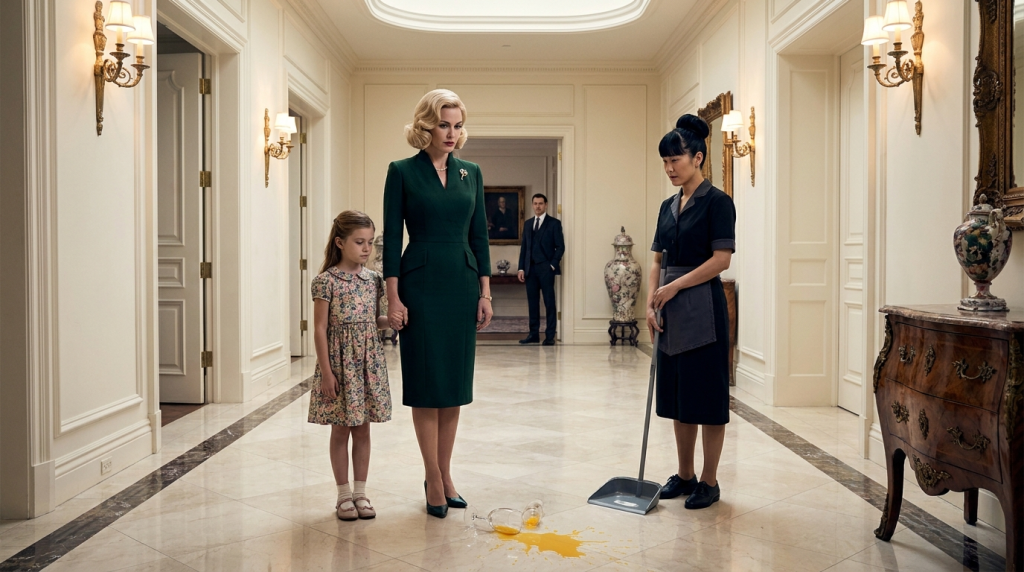
Clean this mess right now,” the fiance ordered the toddler. Then her unexpected words exposed everything. The little girl didn’t drop the glass by accident. She was pushed to it. And the woman who pushed her, she was smiling the whole time, waiting for the embarrassment to land, never once imagining that the door behind her was already opening. But we’ll get to that. First, you need to understand what kind of household this was and what kind of woman Victoria Harlo truly was behind closed doors. The Harlo estate sat on 6 acres outside of Scottsdale, Arizona. 12 bedrooms, a private pool, imported marble floors, and the kind of silence that only comes when people have been trained not to speak unless spoken to.
Marcus Harlo was 45, self-made, quiet in the way that powerful men sometimes are. Not because they had nothing to say, but because they’d learned that words were most effective when used carefully. He’d built his software company from a two- room apartment in Phoenix into a firm worth $300 million. He didn’t shout. He didn’t perform. He simply watched, listened, and decided.
His fianceé Victoria was 34 and she was everything Marcus was not in his personal life. Loud in social rooms, charming at dinner parties, ruthlessly image conscious in public. She dressed like the cover of a magazine and smiled like she was always being photographed. When they were together, people assumed they balanced each other out.
They were wrong. What nobody saw. Not the friends, not the business partners, not the society pages was what Victoria was like inside the house when Marcus wasn’t home. That was a different show entirely. Rosa Menddees had worked for Marcus for 3 years. She was 38, quiet, efficient, and deeply loyal.
She wasn’t hired through an agency. Marcus had met her at a community fundraiser where she’d been volunteering, organizing tables, managing food distribution, running around with a clipboard, and a smile that never faded even when things went sideways.
He’d offered her a position that same evening. She’d asked if she could bring her daughter to work on days when school was out. He’d said yes without hesitation. Her daughter was Lily. Lily was 4 years old. She had her mother’s eyes, dark and wide and full of something that felt like old wisdom wrapped in new skin. She loved juice boxes, building towers with coasters, and following Rosa around the house with the solemn dedication of a very small assistant.
The estate staff adored her. Victoria did not. The first time Victoria made her feelings clear, it was 6 months after Marcus had proposed. Lily had been sitting on the kitchen floor playing quietly while Rosa prepared the afternoon snack trays. Victoria had walked through, glanced down, and said without looking at Rosa, “I’d prefer the child not be on the kitchen floor. It’s unsanitary.” Rosa had apologized and moved Lily to the sitting room. The second time, Lily had laughed too loudly during one of Victoria’s phone calls. Victoria had walked to the doorway of the sitting room and said with a smile that didn’t reach her eyes. Can you control it? Rosa had said nothing. She needed the job. She had no family nearby. And Marcus, wonderful, calm, perceptive Marcus was often traveling. She couldn’t risk the complaint reaching him and being misunderstood. So, she absorbed it. and Victoria, the way some people do when they sense no resistance, pushed harder. By the time spring arrived, it had become routine. Pointed comment here.
A dismissive gesture there. A complaint about Lily’s shoes squeaking on the marble. A demand that Rosa keep Lily on a specific side of the house. The service wing, Victoria had called it. When Victoria was entertaining, Rosa told herself it was just personality, but it wasn’t personality. It was a test. Victoria was testing how much she could take. And then one Thursday afternoon, the test became something else. Marcus had flown to Seattle for a 3-day tech acquisition meeting. He’d kissed Rose’s forehead on his way out. He did that sometimes, the way he would with any member of the household he genuinely liked, and told her he’d be back Friday evening. Victoria had watched from the top of the staircase, holding her coffee. She’d said nothing, but Rosa had felt it, the shift in the air. The way the estate felt different the moment Marcus’s car pulled out of the gate. By noon, Victoria had already changed the tone. She’d come into the dining room where Rosa was polishing the credenza and said, “I’m having three guests for lunch tomorrow. I want this entire room reset, different flowers, and tell the chef, I want the menu changed.” She hadn’t said, “Please.” She hadn’t even looked at Rosa when she spoke. She was scrolling through her phone the whole time, as if issuing the instructions to the air itself. “Of course,” Rosa had said. and keep the child away from the main floor,” Victoria added, already walking away. Last time, she left fingerprints on the glass cabinet. “Disgusting.” Rosa stood still until Victoria’s footsteps faded.
Then she closed her eyes for exactly 3 seconds. Then she kept working. The next morning, the lunch was set. The flowers were arranged. The chef had redesigned the menu. Lily sat quietly in the service wing with her juice box and her coasters, building a tower that kept falling and rebuilding it with the same patient determination. Victoria’s guests arrived at noon. Two women from her social circle, both loud, both polished, both the kind of people who treated staff like furniture. The lunch went smoothly. Too smoothly, as it turned out, because Victoria was bored by smooth. What she wanted was an audience, and Lily, wandering just past the hallway at the wrong moment, accidentally gave her one. The tower had fallen again. Lily had chased one of the coasters as it slid across the floor, and it had rolled just past the service wing boundary down the hall into the edge of the main corridor. Lily followed it. She was four. She didn’t know about invisible lines.
She crouched down to pick up the coaster. right at the edge of the dining corridor. And that’s when Victoria saw her from the end of the table. Paws fell over the lunch. Victoria’s expression changed. Rosa, carrying a tray from the kitchen, saw it all from the corner of her eye and felt her stomach drop. She started walking faster, but not fast enough. Rosa, Victoria called out, not loudly, but with a specific kind of precise projection that made sure everyone in the room heard it clearly. Rosa appeared. Yes. Victoria tilted her head toward Lily. Your daughter is in the main corridor again. I’ll take her back. Wait, Victoria said. Her guests were watching. Victoria stood up slowly from her chair, the way someone does when they want the moment to carry weight. She picked up the crystal juice glass from the table, Lily’s juice, which Rosa had set aside earlier, and she walked to the edge of the corridor. She bent down slightly, holding it out toward Lily. “Here,” she said in a voice that was almost kind. “This was yours, wasn’t it? Come take it.” Rosa stood frozen. Something was wrong. Something about the tone was completely wrong. Lily looked at the glass, then looked at Victoria’s face.
Children notice things adults have learned to ignore. She didn’t reach for it immediately. Take it, Victoria said, and this time there was an edge underneath the sweetness. Lily reached up. Victoria released it. Not fully, just enough. The glass tipped. Juice splashed across the marble floor. The glass didn’t shatter, but it cracked, rolling against the baseboard. The entire corridor went quiet. Victoria straightened up. She looked down at Lily, who was standing in the puddle of juice, wideeyed and stunned. And then she looked at her guests with an expression that said, “See what I have to deal with.” Then she looked at Lily and said loudly and clearly, “Clean this mess right now.” And the room waited because what were they waiting for really? They were waiting for a 4-year-old to cry.
They were waiting for Rosa to rush forward and apologize and clean it herself, humiliated. They were waiting for the performance to land exactly the way Victoria had designed it. But something unexpected happened. Lily didn’t cry. She looked down at the juice on the floor. Then she looked up at Victoria and in a voice that was completely calm, the kind of calm that comes from a child who has not yet learned to be afraid of powerful people, she said, “You dropped it.” The words were small for syllables, but they landed like something heavy in a quiet room. One of Victoria’s guests made a sound, almost a laugh, then quickly suppressed. Victoria’s jaw tightened. Excuse me, you dropped it, Lily said again, still not scared, just factual. I saw you. What happened next? No one expected. Victoria turned to her guests and laughed. But it wasn’t a real laugh. It was the kind of laugh that’s actually an instruction to others. Laugh with me. This is funny.
I’m in control. One guest smiled uncertainly. The other looked at the floor. Victoria turned back to Lily and her voice dropped lower. Clean it up right now or I’ll tell your mommy you were very bad today. Rosa stepped forward. I’ll take care of it. No, Victoria said sharply, hand raised. She looked at Rosa directly. She made the mess. She cleans it. The estate staff, the chef visible at the far kitchen doorway, the housekeeper at the edge of the hall, all stood completely still because they knew something Victoria didn’t. Or rather, they knew something had changed in the past week. Something that Victoria hadn’t been told. 3 days before, Marcus had called Rosa. It was late, and Rosa had stepped outside to take the call. Marcus had been in Seattle, but he’d been thoughtful and he’d said something that had surprised her. I know things haven’t been easy, he said.
I want you to know I see it. I know what’s happening when I’m not there. Rosa had gone very still. You don’t have to protect anyone, he said. Especially not her. If she crosses a line, especially with Lily, I want you to say something. Don’t go quiet. Don’t apologize. Don’t disappear. You have my full backing. Say exactly what needs to be said. Rosa had stood in the evening air for a long moment after the call ended. She’d memorized every word. And now, standing in the corridor with Lily in a puddle of juice, being ordered by a grown woman to clean a floor, Rosa felt those words come back like a key finding a lock. She looked at Victoria and she didn’t move. Victoria, Rosa said quietly. She’s four. I’m aware, Victoria said. She didn’t drop it. You let it fall. We all saw that. The temperature in the corridor changed. Victoria turned fully to face Rosa now.
Her smile was gone. Excuse me, she said. And it was the same word she’d said to Lily, but a completely different thing. This was a warning. I said she didn’t drop it. You handed it to her and let it go. And she’s 4 years old. She doesn’t clean floors. Victoria stepped closer. Her voice dropped to something cold and controlled. You need to be very careful about your tone right now. I’m being completely calm, Rosa said. You are one complaint away from not working here anymore. Rosa met her eyes. I know, sill. Then Victoria smiled. And this time it was genuinely cold.
Okay, she said. She turned to her guests. Why don’t you wait in the sitting room? I’ll join you in a moment. The guests left with a strange, grateful relief of people escaping a scene they didn’t want to witness. The chef disappeared from the kitchen doorway. Victoria turned back to Rosa and this time there was no performance. Just the real her. You want to do this? She said, “Fine, you just ended your job.” Rosa didn’t answer. She reached down, took Lily’s hand, and pulled her gently away from the juice puddle. Lily leaned against Rosa’s leg, and watched Victoria with those serious dark eyes.
Victoria picked up her phone. “I’m calling Marcus,” she said. “Right now.” What? None of them heard because the front entryway was around a corner because the door had opened quietly. Because Marcus Harlo moved through his own house with the same practice silence he used in negotiations. Was the sound of a car in the driveway.
His Seattle meetings had ended a day early. He hadn’t called ahead. He’d wanted to surprise Victoria. He was about to dot. He walked into the main hallway just as Victoria raised her phone to her ear. He saw the juice on the floor. He saw Rosa standing with Lily pressed against her leg. He saw Victoria’s expression, the cold precision of someone who had already decided an outcome. He saw all of it in about 3 seconds. He stopped in the entryway. Victoria heard the footstep. A turn. for one brief flash, so brief you almost missed it. Something crossed her face. Not guilt, calculation, a rapid reshuffleling of the story. She lowered the phone. “Marcus,” she said, and the smile came back immediately, warm and practiced. “You’re home early. I was just about to call you.” “I can see that,” he said.
He walked forward slowly looking at the floor, then at Lily, then at Rosa, then at Victoria. “What happened?” he asked. “Simply, no tone yet. Just the question,” Victoria began. The child was on the main floor again. She dropped the glass. “That’s not what happened. It wasn’t Rosa who said it. It was Lily.” Everyone looked at her. Lily looked up at Marcus with the complete fearlessness of a child who has decided that this man who had once given her the last blueberry muffin from his own plate and called her his little engineer after she built a coaster tower five levels high was safe.
“She dropped it,” Lily said, pointing at Victoria. “And then she said I had to clean it.” But I didn’t drop it. She did. The silence that followed was the kind that fills a room when truth has just walked in wearing plain clothes. Marcus looked at his fiance. Victoria’s expression didn’t change, but her posture did. A slight stiffening, a recalibration. She’s four, Victoria said. She doesn’t understand what she saw. She seems pretty clear, Marcus said quietly. Marcus, I’ve been managing this house. I’d like to hear from Rosa,” he said. Rosa spoke clearly. She didn’t rush. She didn’t add drama. She told him exactly what had happened. The glass, the corridor, the order given to a 4-year-old, the statement that Rosa’s job was over. She left nothing out. When she finished, Marcus was quiet for a long moment. Then he said, “Thank you, Rosa. Can you take Lily to the kitchen? Ask Chef Daniel to make her whatever she wants. Rosa nodded. Lily looked up at Marcus and completely unprompted said. She was mean. Marcus crouched down to eye level. I know, he said softly. I’m going to fix it. Okay.
Lily nodded satisfied. She took Rose’s hand and they walked toward the kitchen. The little girl’s shoes squeaking on the marble. The same squeak Victoria had complained about for months. This time, nobody told her to stop. Marcus stood up. He and Victoria were alone in the corridor. The juice was still on the floor. The cracked glass was still against the baseboard. Victoria began immediately. You don’t know the full picture. Rosa has been. I know exactly what’s been happening, Marcus said. For months, Victoria stopped. I travel a lot, he said. I know what that looks like to the people who stay. It looks like an open window. Like rules can be different. Like nobody’s watching, he paused. I’ve been watching. That’s not fair. The chef sends me notes, Marcus said simply.
So does Thomas. So does Angela. They don’t do it maliciously. They do it because they care about this house and the people in it. The color shifted in Victoria’s face. I’ve been patient, he said, because I wanted to believe what I saw in you publicly was who you actually were. Gave it time. That was my mistake. Marcus, if you would just listen. You told my employee who has worked for me for 3 years, who brings her four-year-old child to this house because I invited her to that she was one complaint from losing her job. Because her daughter saw the truth and said it out loud. He let that sit. A 4year-old, he said again, “Quiet now.” Victoria looked at the floor, and for the first time, the calculation stopped working. There was no version of this story she could reshape fast enough. The guests were in the other room. A chef knew. Rosa knew. Lily, four years old, with a memory of a child who hadn’t yet learned to forget what they see, knew. She had built the trap herself. Walked into it herself, and the door had closed behind her. “I want you to understand something,” Marcus said. “I’ve built everything I have by reading people. It took me longer than it should have with you, and I’ll take responsibility for that. But I’m reading you now. Clearly, Victoria said nothing. You chose a child, he said, not in anger, not by accident. You chose her deliberately because you thought she was small enough to not matter. And you thought Rosa would be quiet because she needed her job. He looked at her evenly. That’s not a personality flaw.
That’s character. The word landed like a verdict. The engagement, he said, is over. Victoria’s guests, sensing the shift in energy, had quietly let themselves out through the side door. They would talk about this for years. What they had seen, what they had almost seen, what the silence had meant. But they weren’t in the room for what came next. Victoria left within the hour. She didn’t beg. That surprised people later when the story circulated. They expected drama, tears, the full performance, but there was none. Because some people when the audience disappears have nothing left. The performance requires an audience alone with someone who sees through it. They simply go. She took her luggage to call the car. She walked out through the front door without looking back at the marble floors. the imported fixtures, the life she had spent 6 months treating as a stage set. Marcus stood at the window and watched the car leave. He stood there for about 2 minutes.
Then he went to the kitchen. Lily was sitting on the counter, which Rosa never normally allowed, but Chef Daniel had made an exception, eating a bowl of blueberries and a grilled cheese sandwich cut into triangles, which she had specifically requested. She looked up when Marcus came in. She left,” Marcus said. Lily considered this while chewing. “Good,” she said. Chef Daniel turned away to hide his expression. Rosa looked up from the far counter where she’d been quietly replating some of the abandoned lunch items. Her eyes met Marcus’. He said, “I owe you an apology, Rosa.” She shook her head. “You don’t. I do. I should have moved faster. I should have said something sooner. He paused. I’m sorry you had to absorb that.
I’m sorry Lily was part of it. Rosa was quiet for a moment. Then she said very softly. She handled it better than most adults would have. They both looked at Lily, who was now arranging blueberries into a pattern on her plate with a focused seriousness of an engineer solving a problem. She said, “You dropped it.” Marcus said she saw clearly. Rosa said, “She always does.” Marcus nodded slowly. “Some people just see things straight.” Before the world teaches them not to. There was a meeting the following week formal with lawyers to finalize the end of the engagement. Victoria arrived polished and composed. And in a brief moment when they were alone, she said, “You chose a staff member over your fiance.” Marcus looked at her for a long moment.
Then he said, “I chose character over performance. She’s been demonstrating character everyday for 3 years. You showed me yours.” With a juice glass and a 4year-old, he signed the paperwork. Left. Three months later, Marcus made a change to the household arrangements. He called Rosa into his office and told her that the service wing designation, Victoria’s rule, as the staff quietly called it, was obviously no longer in effect. Lily could go anywhere in the house she wanted. He’d had a small reading corner set up in the library with a little shelf at Lily’s height because he’d noticed she liked looking at the spines of the books even when she couldn’t read them yet. Rosa looked at him. You didn’t have to do that, she said. I know, he said. That’s why I did it. 6 months after that, on a Tuesday evening, when Lily had fallen asleep in the library armchair with an open picture book on her lap, Marcus sat at his desk watching her from across the room. It was a specific kind of quiet, the kind that comes after chaos has passed and settled. He thought about what Victoria had called her. He thought about what Lily had said when the juice hit the floor. You dropped it for words. Completely accurate.
Completely unafraid. He’d spent his whole career making highstakes decisions in rooms full of people who spoke carefully, who measured every word for advantage, who said what they needed to say to control the outcome. And a 4-year-old in a juice stained dress had walked into that corridor and just told the truth without hesitation, without calculating the cost. He smiled to himself in the quiet library. Some people, he thought, just see things straight. Before you go, think about what really happened in that corridor. Victoria didn’t lose because Marcus came home early. She didn’t lose because Rosa finally spoke up. She didn’t lose because the guests heard. She lost because she chose the wrong target. She chose someone small, thinking small meant silent. She chose someone young, thinking young meant invisible. She chose the wrong moment in the wrong house in front of the wrong man. And the person who exposed her wasn’t a lawyer or a staff member or an angry confrontation. It was a 4-year-old girl with a blueberry who looked up and said what she saw. She dropped it. What would you have done in Rose’s position? Would you have stayed quiet to protect your job? or would you have spoken up knowing what it might cost you?
The transition of the Harlow estate did not happen in a single, cinematic sweep. It happened in the quiet, methodical way Marcus built everything in his life: with intention, observation, and an absolute refusal to return to a broken system.
For the first year after Victoria’s departure, the house breathed differently. The tension that had previously hummed in the imported marble floors and the grand staircases dissipated. The staff stopped walking on eggshells. Chef Daniel began humming in the kitchen again. And Lily, now five years old, had claimed the library as her undisputed sanctuary, her coaster towers replaced by complex structures built from architectural blocks Marcus had quietly ordered for her.
But the most profound shift occurred not in the house, but in Rosa.
Marcus had spent his entire career identifying underutilized assets and raw potential. Over the months following the incident in the corridor, he began to observe Rosa not as a housekeeper, but as a manager. He noticed how she orchestrated the estate’s complex vendor schedules without a single overlap. He watched her manage the household budget with a ruthless efficiency that outpaced some of his corporate logistics directors.
One evening, he found her sitting at the kitchen island long after her shift had ended, reviewing a massive binder of catering and security contracts for an upcoming charity gala he was hosting.
“You found a discrepancy,” Marcus noted, stepping into the kitchen and pouring himself a glass of water. It wasn’t a question; he could read the slight furrow in her brow.
Rosa looked up, momentarily startled, but she didn’t close the binder. A year ago, she might have. “The security firm is double-billing for the perimeter detail,” she stated plainly. “They’ve factored in the weekend premium rate, but the contract stipulates a flat fee for philanthropic events. It’s an overcharge of twelve thousand dollars.”
Marcus leaned against the counter. He didn’t smile, but a deep, recognizing light appeared in his eyes. “You caught that by reading the fine print of a fifty-page vendor agreement?”
“I don’t like when people assume they can take advantage of a system because they think no one is reading,” Rosa replied softly, her eyes returning to the numbers.
The following Monday, Rosa Mendez was no longer the estate’s housekeeper. Marcus moved her into Harlow Technologies’ corporate headquarters as a Junior Logistics Coordinator. He paid for her to finish the business management degree she had abandoned years ago when Lily was born. It wasn’t charity; it was an investment. And like all of Marcus’s investments, it paid dividends that would soon save his entire empire.
While Marcus and Rosa were building a foundation of mutual respect and operational brilliance, Victoria Harlow was not simply fading into the Arizona desert.
People like Victoria do not experience rejection as a moment for self-reflection; they experience it as an injury that requires vengeance. The loss of the Harlow fortune, the humiliation of being dismissed because of a housekeeper and a toddler, had metastasized into a cold, calculating obsession.
Within eighteen months, Victoria had woven herself into the inner circle of Julian Vance, a 50-year-old venture capitalist whose firm, Vanguard Dynamics, was Harlow Technologies’ most aggressive rival. Julian was wealthy, but he lacked Marcus’s visionary instinct. What he did have, however, was a willingness to play dirty—and Victoria possessed exactly the kind of intimate knowledge he needed.
Victoria and Julian devised a strategy to sabotage Harlow Technologies’ upcoming acquisition of a revolutionary AI security firm. The goal was simple: leak Harlow’s proprietary valuation metrics to the press, trigger a panic among the board of directors, and allow Vanguard Dynamics to swoop in and steal the acquisition.
To execute this, Victoria needed access to Marcus’s private home network, where he often reviewed sensitive documents late at night. She knew the estate’s security was impenetrable from the outside. The breach had to come from the inside.
Victoria remembered the staff. She remembered the people she had treated as invisible. She assumed they were vulnerable to a price tag.
She targeted a newly hired groundskeeper, a young man named Elias, paying him a staggering sum to plant a discreet signal repeater in the estate’s garden, just outside the window of Marcus’s home office. It was a flawless plan, built on the assumption that the working class could always be bought.
She forgot, however, that loyalty cannot be outbid when it has been genuinely earned.
By the time Lily turned six, Rosa had been promoted to Director of Internal Operations. She moved with a quiet, unshakeable authority. She wore tailored suits instead of a uniform, but she never lost the humble vigilance that had kept her alive during her hardest years.
It was a Tuesday afternoon when the threads of Victoria’s plot began to unravel.
Rosa was reviewing the estate’s updated security logs—a habit she maintained out of protective instinct for the house that had sheltered her and her daughter. She noticed a recurring anomaly.
11:42 PM (Tuesday): Micro-fluctuation in the estate’s localized Wi-Fi mesh network near the West Garden.
12:15 AM (Thursday): Secondary fluctuation, exactly mirroring Marcus’s login times to his secure corporate VPN.
01:30 AM (Saturday): Unregistered MAC address pinging the router from a physical proximity of less than fifty feet.
Rosa didn’t panic. She didn’t alert Marcus immediately. She applied the same meticulous, clipboard-ready logic she had used at community fundraisers years ago.
She bypassed the corporate security team and went directly to the people who truly knew the estate: the staff. She sat down with Chef Daniel and Thomas, the head of security. Within an hour, they had isolated Elias’s strange behavior—his tendency to linger near the office windows, his sudden purchase of an expensive watch.
When Rosa confronted Elias quietly in the service corridor, she didn’t threaten him. She simply laid out the evidence and looked at him with the profound disappointment of someone who knew the value of an honest dollar. Elias, crumbling under the weight of his own guilt and Rosa’s unyielding gaze, confessed everything. He handed over the physical repeater and the burner phone Victoria had used to contact him.
Rosa now had a choice. She could hand this over to the police, quietly neutralizing the threat. But she knew that wouldn’t stop Victoria. Victoria needed to be dismantled in the only arena she cared about: the court of public opinion.
Rosa spent the next 72 hours working in absolute secrecy, compiling a dossier that would not just protect Marcus, but expose the rot at the heart of Vanguard Dynamics.
When Marcus read the dossier in his office, the silence in the room was absolute. He looked up at Rosa, who stood across his desk, calm and composed.
“You didn’t just stop a data breach, Rosa,” Marcus said, his voice carrying a rare, profound awe. “You baited them. You fed Julian Vance the false metrics.”
“They are preparing to launch a hostile bid tomorrow at the tech summit based on those false metrics,” Rosa confirmed smoothly. “When they present their numbers, they won’t just be wrong. They will be actively holding stolen, traceable data in front of the entire industry.”
Marcus leaned back in his chair. He thought about the woman who had once polished his dining room credenza in silence. He thought about the sheer, terrifying brilliance of a mother who had learned to anticipate every danger to protect her child.
“Let’s go to the summit,” Marcus said.
The Global Tech Innovators Summit in Phoenix was the social and corporate event of the season. The grand ballroom of the Biltmore Hotel was filled with the elite of the software world, venture capitalists, and the media.
Victoria arrived on the arm of Julian Vance, wearing a stunning crimson gown, her smile as sharp and practiced as ever. She felt the thrill of imminent victory. Tonight, Vanguard Dynamics would announce their counter-bid, humiliating Marcus Harlow publicly and destroying his legacy.
Marcus arrived thirty minutes later. He did not walk in with a socialite. He walked in with his Director of Internal Operations.
Rosa wore an elegant, understated charcoal evening gown. She moved with a grace that made the old money in the room turn their heads. And holding Marcus’s left hand, skipping slightly on the plush carpet in a dark blue velvet dress, was six-year-old Lily.
When Victoria saw them from across the ballroom, her smile faltered. The sight of the former housekeeper standing as an equal beside one of the most powerful men in the state—and the child who had ruined her life—sent a spike of pure, unadulterated rage through her veins.
The keynote presentation began. Julian Vance took the stage. With sweeping, confident gestures, he announced Vanguard Dynamics’ aggressive move to acquire the AI security firm, flashing a series of financial projections on the massive screen behind him.
“We have evaluated the market,” Julian boasted to the crowd, his eyes locking onto Marcus. “And we know exactly what this technology is worth. Our internal metrics prove that our competitors are drastically overvaluing this asset.”
He displayed the numbers. The exact, flawed numbers Rosa had fed through the dummy server.
Marcus stood up from his front-row table. The room went silent. He didn’t shout. He didn’t perform. He simply walked to the microphone stand at the edge of the stage.
“Julian,” Marcus said, his voice echoing through the ballroom. “Those are fascinating metrics. I’m particularly interested in them because those exact figures were generated by my Director of Operations three days ago on a secure, decoy server.”
A collective murmur rippled through the hundreds of attendees. Julian’s face went completely pale.
“What are you talking about, Marcus?” Julian stammered, gripping the podium. “These are Vanguard’s independent analytics.”
Marcus gestured for Rosa to stand. “Rosa Mendez discovered an illegal signal repeater planted on my private property, funded by a shell account tied directly to your firm. You aren’t presenting independent analytics, Julian. You are publicly confessing to corporate espionage.”
The flash of cameras suddenly erupted from the press pool at the back of the room. Victoria, standing near the edge of the stage, took a step backward, her breath hitching. The calculated world she had built was collapsing in real-time.
“This is absurd!” Victoria shouted, her composure finally breaking, the ugly, shrill panic bleeding through the polished facade. “He’s lying! That woman is a maid! She’s a nobody who manipulated her way into his company!”
The room fell into a dead, horrifying silence. The elite crowd stared at Victoria, watching the veneer of class peel away to reveal the raw entitlement underneath.
Lily, standing beside Rosa, looked at Victoria. She didn’t hide behind her mother. She didn’t cry. She possessed the same quiet, devastating clarity she had at four years old. She took one step forward, her velvet dress swishing, and pointed a small finger at the massive presentation screen.
“You stole my mommy’s fake numbers,” Lily said, her voice carrying the pure, bell-like pitch of a child. “And now everyone knows you’re a thief.”
The simplicity of the statement broke the tension. A few people in the back actually laughed—not the nervous, instructed laugh Victoria used to demand, but a genuine, mocking laugh at the sheer absurdity of a billionaire venture capitalist being outsmarted by a former housekeeper and publicly summarized by a six-year-old.
Julian Vance backed away from the podium, realizing his career had just ended. He didn’t look at Victoria. He practically ran from the stage, leaving her standing alone in her crimson dress, entirely exposed, stripped of her power, her status, and her audience.
The fallout was swift and brutal. Vanguard Dynamics’ stock plummeted the following morning. The SEC launched an immediate investigation into Julian Vance, leading to federal indictments. Victoria, implicated in the wire transfers, was forced to liquidate whatever assets she had left to pay for a defense attorney. She became a pariah in Scottsdale, her name whispered in country clubs not with envy, but with profound disgust. She had chased status at the expense of humanity, and in the end, she was left with neither.
Marcus Harlow’s acquisition of the AI firm went through flawlessly. The company’s value skyrocketed, cementing his legacy as one of the most formidable minds in the industry.
But the true victory was not found in the boardrooms or the stock market. It was found on a quiet Sunday afternoon back at the estate.
The Arizona sun was setting, casting a warm, golden light across the patio. Marcus sat at the outdoor dining table, reviewing a philanthropic initiative. Across from him sat Rosa, relaxed, sipping a cup of coffee, reviewing the same document. They moved in tandem now, a partnership forged in the fires of mutual respect, unspoken understanding, and an unyielding commitment to integrity.
They were not just employer and executive anymore. They had become something deeper, an anchor for one another in a world that so often valued the superficial.
Down on the lawn, Lily was building a massive fortress out of large foam blocks. She paused, inspecting the structural integrity of her work, and then looked up at Marcus and Rosa.
“It’s strong now,” Lily announced proudly. “It won’t fall down.”
Marcus looked at the little girl, then looked across the table at Rosa. He saw the resilience in her eyes, the quiet strength that had weathered poverty, cruelty, and the viciousness of the elite, only to rise above it all with her soul entirely intact.
“She’s right,” Marcus said softly, reaching across the table and resting his hand gently over Rosa’s. “It’s strong now. None of it is ever falling down again.”
Rosa looked at his hand, then up into his eyes, and for the first time in her life, she didn’t just feel safe. She felt like she was exactly where she belonged.
True power is never loud. It does not demand that a child clean a floor, and it does not force laughter from an unwilling audience. True power is the quiet courage to see the truth, the patience to let a lie destroy itself, and the wisdom to understand that the greatest empires are not built on marble floors, but on the unshakeable character of the people standing on them.