👁 23 views
CHAPTER 1: The Flinch That Told A Thousand Nightmares
I’ve been an emergency trauma vet for fifteen years, patching up the absolute worst of what humanity does to animals, but nothing prepared me for the pregnant Doberman they wheeled into my clinic on a rainy Tuesday night.
My clinic sits on the edge of the city, a gritty, concrete building where the worst cases are dumped.
I usually work with retired K-9 units and police Belgian Malinois—dogs trained to leap fences and pin armed suspects to the ground without hesitation.
I’m used to fierce, unbreakable animals.
But the dog shivering on the cold steel of my examination table was completely shattered.
Animal control had found her tied to a rusted chain-link fence behind an abandoned warehouse.
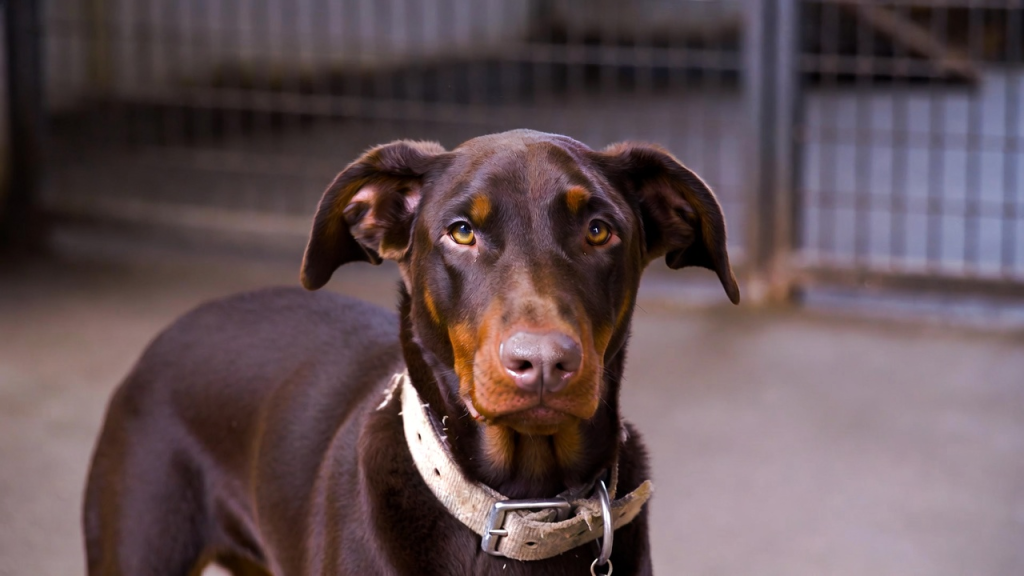
She was a Doberman Pinscher, a breed known for its proud stance and fearless loyalty.
But there was no pride left in her.
Her ribs jutted out sharply against her dark coat, forming a cruel contrast to her heavily swollen belly.
She was weeks away from giving birth, carrying a litter of innocent pups while slowly starving in the freezing rain.
But her physical condition wasn’t what made my chest tighten.
It was her eyes.
Every time one of my veterinary techs stepped close to the table, the dog would violently flinch.
If someone raised a hand to adjust the overhead light, she ducked.
If someone reached for her chart, she cowered, pressing her fragile body flat against the metal table.
But the most heartbreaking reaction happened whenever someone tried to pet her.
The moment a human hand moved anywhere near her face, her amber eyes would squeeze shut in absolute terror.
She didn’t growl. She didn’t bare her teeth.
She just surrendered to the pain she was certain was coming.
I told my staff to step back and leave the room.
The harsh fluorescent lights buzzed above us as I stood alone with her in the quiet exam room.
I took a deep breath, lowering my posture to make myself as small and unthreatening as a tall man could be.
I didn’t reach for her from above. That’s a mistake most people make.
Instead, I kept my hands low, palms facing up, and slowly moved a few inches closer.
Her body trembled so hard the metal table rattled.
Her eyes squeezed shut again, bracing for the strike.
But the strike never came.
Instead, the back of my fingers gently grazed the soft fur just beneath her chin.
I kept my hand perfectly still, letting the warmth of my skin seep into her freezing body.
For a long, agonizing minute, she stayed frozen with her eyes locked shut.
And then, something shifted.
She let out a long, ragged exhale—a sound that carried months, maybe years, of pure torment.
Her tense muscles suddenly gave out.
Her heavy, beautiful head dropped straight down, collapsing completely into the palms of my hands.
She pressed her snout against my skin, burying her face in my hands as a tiny whimper escaped her throat.
Tears blurred my vision. I carefully stroked the sides of her face, whispering that she was finally safe.
But as my thumbs moved down the sides of her neck to feel her pulse, my blood ran ice cold.
Beneath her dark fur, completely invisible to the eye, my fingers brushed against something hard, sharp, and deeply embedded in her flesh.
It wasn’t a normal collar.
And as I gently parted her fur to see what was hiding underneath, I realized the nightmare this dog had survived was far darker than I ever could have imagined.
CHAPTER 2: The Rusted Metal Buried Deep Inside Her Flesh
As I gently parted the thick, dark fur around the Doberman’s neck, the fluorescent lights of the exam room illuminated a nightmare that instantly made my stomach violently churn.
What my fingers had brushed against wasn’t a standard buckle. It wasn’t a heavy-duty nylon collar or even a harsh training chain.
It was a homemade device of pure, calculated torture.
Buried deep beneath the overgrown hair, completely hidden from a casual glance, was a thick ring of rusted, heavy-gauge industrial wire.
But it wasn’t just wire.
Spaced evenly around the circumference of this crude, metal loop were thick, galvanized steel bolts and rusted roofing nails, all deliberately turned inward.
The sharp, jagged points of the metal were facing directly into the dog’s delicate throat.
For a moment, I stopped breathing. The sheer malice required to construct something like this, to deliberately place it on an animal, and to twist it tight enough that it couldn’t be removed, defied every shred of humanity I still believed in.
This wasn’t an accident. This wasn’t a case of a dog outgrowing a puppy collar.
This was a medieval torture device, specifically engineered to inflict maximum suffering with every single movement she made.
Suddenly, her terrifying behavior made absolute, heartbreaking sense.
The reason she violently flinched every time someone raised a hand near her face. The reason she squeezed her eyes shut and flattened her body in pure panic.
Whenever anyone had tried to pet her neck, whenever she had been pulled by a leash, or even when she just tried to swallow a piece of food, the pressure would force those rusted spikes deeper into her flesh.
She had learned the hardest way possible that human touch equaled excruciating, piercing agony.
She hadn’t been cowering just out of fear. She had been bracing for the sharp, biting pain of the nails tearing into her skin.
I leaned in closer, carefully holding her fur back, and the true extent of the damage became horrifyingly clear.
The metal had been on her neck for a very long time. Weeks, maybe months.
Her skin had literally begun to grow over the rusted wire in certain places, attempting to heal around the foreign object.
The entry points where the nails had repeatedly punctured her neck were weeping with dark, discolored fluid.
As I shifted the fur, the unmistakable, sickly-sweet odor of severe, necrotic infection filled the small space between us. It was the smell of decaying tissue, a scent that every trauma vet knows instantly and dreads deeply.
My heart hammered aggressively against my ribs.
She was heavily pregnant. Her immune system was already heavily compromised, pouring every ounce of its energy into keeping the puppies inside her belly alive while the mother starved.
This festering infection on her neck was a ticking time bomb. If the bacteria entered her bloodstream and caused sepsis, it would kill her. And it would undoubtedly kill every single puppy she was carrying.
“Sarah!” I shouted, my voice cracking slightly with an intensity I hadn’t used in years.
My eyes never left the dog. I kept my hands perfectly still, my palms still supporting her heavy, exhausted head. “Sarah, get in here right now! Bring the heavy bolt cutters, the wire snips, and an emergency trauma kit. Hurry!”
Seconds later, the exam room door swung open.
Sarah, my head veterinary technician, rushed in. Sarah is a tough, no-nonsense professional who has been by my side for over a decade. We’ve pulled dogs out of burning buildings and pieced together animals hit by speeding trucks. I’ve seen her perform CPR on a newborn puppy without breaking a sweat.
But when she stepped up to the metal table and saw what I was looking at, she physically recoiled.
She stopped dead in her tracks, the color draining completely from her face. Her hand flew up to cover her mouth.
“Oh my god,” Sarah whispered, her voice trembling. “Doc… what is that?”
“It’s a homemade spiked collar,” I said, my voice low and tight. “The spikes are facing inward. It’s deeply embedded in the subcutaneous tissue, and there’s a massive secondary infection. We need to get it off her right this second.”
Sarah snapped out of her shock, her training instantly kicking in. She spun around, rushing to the surgical prep area down the hall.
I stayed with the Doberman. She hadn’t moved an inch since she dropped her head into my hands. Her amber eyes were still squeezed tightly shut, her breathing shallow and ragged.
“I know, sweetheart,” I whispered, keeping my tone as soft and rhythmic as a lullaby. “I know it hurts. I know what they did to you. But it ends tonight. I promise you, it ends right now.”
I could feel the heat radiating from the infected wounds on her neck. Her body temperature was undoubtedly spiking.
The metal table was freezing, yet she was panting lightly, a clear sign of systemic distress.
When Sarah returned, her arms were loaded with heavy, sterilized instruments. She placed a large metal tray on a rolling cart next to the exam table.
On it, she laid out a pair of heavy-duty industrial bolt cutters, surgical wire snips, hemostats, thick leather gloves, and a row of syringes.
“Do we sedate her?” Sarah asked, her eyes darting to the dog’s massive, swollen belly.
That was the impossible dilemma.
In a normal situation, I would have immediately administered a heavy dose of general anesthesia. I would have put the dog completely under, safely and painlessly cutting the metal away while she slept, and then surgically debriding the dead tissue.
But she wasn’t just one patient. She was carrying a litter.
“We can’t,” I said, shaking my head grimly. “Look at her body condition. She’s severely emaciated, dehydrated, and septic. If we put her under general anesthesia right now, her heart might stop. And even if she survives it, the anesthetics will cross the placental barrier. It will shut down the puppies’ respiratory systems. They won’t make it.”
Sarah swallowed hard, nodding in understanding. “So we do it awake.”
“We do it awake,” I confirmed. “We use local blocks only. Lidocaine around the puncture sites. But Sarah… to get this wire off, I’m going to have to pull the spikes out of her flesh before I can cut the loop. It’s going to hurt her. And she’s absolutely terrified of hands.”
We stood in silence for a fleeting moment, the heavy weight of the situation pressing down on us.
We had to inflict acute pain on an animal that had already been tortured to the brink of death, and we had to ask her to trust us while we did it.
“Draw up the lidocaine,” I instructed. “Give me a mix with bupivacaine so the numbness lasts longer. We’ll do multiple small injections around the worst of the embedded nails.”
Sarah worked quickly, filling the syringes.
I gently adjusted my grip on the Doberman. I didn’t want to restrain her forcefully. Force had been the language of her abusers. Force would only trigger a violent panic response.
Instead, I asked Sarah to stand at the dog’s front.
“Just hold her paws,” I said. “Don’t pin her down. Just hold her feet gently, let her know you’re there, and talk to her.”
Sarah stepped up, gently placing her hands over the dog’s large, trembling front paws. She leaned her face close to the dog’s ear, whispering soft, continuous praise.
I picked up the first syringe. The needle was incredibly fine, but any touch to her neck was a trigger.
“I’m sorry, girl,” I murmured.
I found the first major puncture wound, a deep, angry hole where a rusted bolt had driven into the muscle behind her right ear.
As I carefully slid the needle beneath the skin to inject the numbing agent, the Doberman flinched violently.
A sharp, high-pitched yelp tore from her throat. Her eyes snapped wide open, flashing with pure, unadulterated panic. She tried to pull away, her paws scrabbling against the slick metal table.
“Easy, easy, I’ve got you,” Sarah cooed, keeping her hold incredibly light but steady. “You’re okay, mama. You’re so brave.”
The dog froze, panting heavily. She looked at me, her amber eyes wide with confusion. She expected me to strike her for moving. She expected punishment.
When I simply stood still, keeping my hands visible and open, a profound realization seemed to wash over her.
She let out a long, shuddering breath, closed her eyes again, and remarkably, leaned her head back toward me.
She was offering her neck. She was trusting me.
Tears pricked the back of my eyes. In fifteen years of veterinary medicine, I had never seen an animal display that level of conscious trust after enduring such horrific abuse.
I worked methodically, injecting the local anesthetic around the circumference of the torturous collar. I targeted the six main entry points where the metal had buried itself the deepest.
We waited five agonizing minutes for the medication to take effect. The clinic was dead silent, save for the buzzing of the lights and the harsh sound of her breathing.
“Okay,” I said quietly, reaching for the heavy bolt cutters. “Let’s get this thing off.”
The metal was incredibly thick. Standard surgical snips wouldn’t even dent it. I had to use the large, heavy-handled cutters usually reserved for cutting through thick chain-link fences.
The problem was the lack of space.
Because the wire was pulled so tight against her throat, there was almost no room to slide the heavy blades of the cutters beneath the metal without crushing her windpipe.
“I need to lift it slightly to get the blades under,” I told Sarah. “When I lift it, the spikes on the other side are going to pull.”
Sarah nodded, leaning closer to the dog, resting her forehead gently against the Doberman’s shoulder.
I slid my gloved fingers underneath a section of the rusted wire near the back of her neck, right at the nape where the skin was thickest.
Taking a deep breath, I pulled upward.
The sickening sound of metal sliding out of wet tissue filled the room.
The dog let out a low, guttural moan. Her whole body went rigid, but she didn’t try to bite. She didn’t try to run. She just endured it, shivering violently.
I quickly slid the bottom jaw of the bolt cutters beneath the lifted wire.
“Got it,” I muttered.
I gripped the heavy red handles of the cutters with both hands. It took every ounce of strength in my arms to squeeze them together.
The rusted metal fought back, thick and unyielding. My muscles burned, my knuckles turning white as I forced the blades through the heavy gauge wire.
With a loud, sharp CRACK that echoed off the tile walls, the metal finally gave way.
The continuous loop of the collar was broken.
But the nightmare wasn’t over. Breaking the wire was only the first step. The device was so stiff and so deeply embedded that it didn’t just fall off.
I had to manually pull the two ends apart, bending the thick steel backward to slide the rusted nails out of her flesh one by one.
“Almost there, sweet girl. Almost there,” I whispered, my own forehead beaded with sweat.
I took hold of the left side of the wire. Carefully, inch by agonizing inch, I pulled it away from her throat.
Two rusted roofing nails slid out of the inflamed tissue on her left side. Thick, dark blood immediately began to well up from the open puncture wounds, cascading down her dark fur.
Then, I moved to the right side. This side was worse.
A large, jagged bolt had buried itself perilously close to her jugular vein. The tissue around it was severely swollen and necrotic.
“Sarah, grab the hemostats and some gauze. When I pull this bolt out, if it nicks the vein, we are going to have heavy bleeding.”
Sarah dropped one of the dog’s paws and snatched up a thick stack of sterile gauze pads, holding them at the ready.
I gripped the right side of the metal device. I held my breath, praying that the abuser hadn’t driven the metal deep enough to pierce the major blood vessels.
With a smooth, steady motion, I pulled the final section of the collar away from her neck.
The bolt slid free.
Blood immediately rushed from the wound, but it was dark, venous blood mixed with the fluid of the infection. It wasn’t the bright red, pulsing spray of a severed artery.
We had missed the jugular by less than a millimeter.
“Pressure!” I commanded.
Sarah instantly pressed the thick stack of gauze against the dog’s neck, applying firm, steady pressure to stop the bleeding.
With both hands, I finally pulled the horrific device completely free from the dog’s body.
I dropped it onto the metal tray.
It hit the stainless steel with a heavy, sickening CLANG.
The sound made the Doberman flinch one last time. But then, almost immediately, she realized the constant, suffocating pressure was gone.
The terrible biting pain that had plagued her every waking moment had miraculously vanished.
She let out a massive, shuddering sigh. Her entire body, which had been tight as a coiled spring since she arrived, suddenly went entirely limp.
She melted into the exam table. Her head rested heavy against the cool metal.
For the first time since she had been brought into my clinic, she opened her eyes completely.
They were a deep, soulful amber. And as she looked up at me, the veil of terror that had clouded them was gone. In its place was an exhaustion so profound it was hard to witness.
“You did it, girl,” I whispered, stripping off my bloody gloves. “It’s gone. It’s never going to hurt you again.”
We spent the next forty-five minutes carefully cleaning and debriding the wounds on her neck. We flushed the deep puncture holes with copious amounts of warm chlorhexidine solution, washing away the necrotic tissue and the dangerous bacteria.
I packed the deepest cavities with an antibiotic ointment that would fight the infection locally without harming the puppies. Finally, we wrapped her neck in soft, clean, white bandages.
She looked like a war casualty, but she was resting comfortably. The local anesthetic had completely numbed the area, and for the first time in months, she was truly pain-free.
But my job wasn’t done.
The mother was stabilized, but we still didn’t know the status of the fragile lives growing inside her.
“Let’s get the ultrasound,” I said, my voice heavy with exhaustion. “We need to know if the pups survived the stress.”
Sarah wheeled the portable ultrasound machine to the side of the table.
The Doberman watched us with calm, curious eyes. The violent flinching was completely gone. Now that the collar was off, she realized our hands brought relief, not agony.
I gently clipped a small, rectangular patch of fur from her tight, swollen abdomen. Her belly was completely distended, the skin stretched thin over her heavy load.
I applied a generous amount of warm acoustic gel to the probe.
“Okay, mama,” I murmured, placing the probe against her skin. “Let’s see what you’re hiding in there.”
I turned my attention to the small, glowing monitor. Black and gray static flickered for a moment before the image resolved into the unmistakable shapes of fluid-filled sacs.
I moved the probe slowly across her abdomen.
Suddenly, a tiny, rapidly flickering white light appeared in the center of the screen.
It was a heartbeat.
Fast, strong, and perfectly rhythmic.
“There’s one,” Sarah whispered, a massive smile breaking across her tired face.
I moved the probe slightly to the left. Another flickering light. Then another. And another.
“Two… three… four,” I counted out loud, my own heart swelling with a massive wave of relief.
I mapped out the entire uterus. I counted seven distinct, strong heartbeats. Seven tiny lives that had somehow survived starvation, freezing rain, severe infection, and the unimaginable torture their mother had endured.
The puppies were alive. They were active. And based on the calcification of their tiny skeletons on the screen, they were fully developed.
“They’re huge,” I noted, looking closely at the measurements on the screen. “She is incredibly close. She could go into labor at any moment. The trauma and the adrenaline drop might trigger it tonight.”
“We’ll set up the whelping box in the quiet room in the back,” Sarah said, already moving toward the door. “I’ll get the heat lamps and the blankets.”
“Make it as warm and dark as possible,” I agreed. “She needs absolute peace.”
As Sarah left to prepare the room, I stayed behind to clean up the surgical tray.
The heavy, rusted torture device still sat in the center of the metal cart, surrounded by bloody gauze and empty syringes.
I stared at it, a deep, burning anger rising in my chest.
Who does this? What kind of monster constructs something so deliberately evil, attaches it to a pregnant animal, and then ties her to a fence to die in the freezing rain?
I reached out with a clean gloved hand and picked the heavy metal ring up by the wire, careful to avoid the sharp, rusted spikes.
I wanted to examine it closer. I wanted to hand it over to the animal cruelty investigators as evidence. I wanted the person who built this to rot in a federal prison.
I turned the heavy device over in my hands under the bright exam lights.
The wire was coarse and heavily oxidized. The bolts were standard hardware store variety. But as I rotated the collar to look at the section that had been sitting at the very back of the dog’s neck—the part hidden under the thickest fur—my breath caught in my throat.
Woven into the twisted wire, covered in dried blood and completely obscured until the collar was removed and cleaned, was a small, heavy piece of metal.
It wasn’t a standard dog tag. It wasn’t a rabies vaccine identifier.
It was a thick, rectangular piece of brushed steel, roughly the size of a military dog tag, but much heavier.
I grabbed a piece of gauze soaked in alcohol and vigorously rubbed the dried blood and grime away from the surface of the metal tag.
As the dark red crust flaked away, deeply engraved letters and numbers began to reveal themselves under the harsh clinic lights.
My blood ran instantly ice cold.
The hairs on the back of my neck stood straight up.
I stared at the heavy metal tag, my mind struggling to process what I was looking at.
The engraving wasn’t an address. It wasn’t a phone number.
It was a highly specific, serialized identification code. And beneath that code was a stamped insignia that I recognized immediately.
It was an insignia that belonged to a highly classified, heavily guarded facility located less than fifty miles from my clinic—a facility that officially did not house, train, or work with dogs.
This Doberman wasn’t a random stray abused by a neighborhood monster.
She was a piece of property.
And the people who owned her were going to realize she was missing.
CHAPTER 3: The Classified Insignia And The Knock At Midnight
I stood frozen under the harsh, buzzing fluorescent lights of the exam room, my thumb nervously tracing the deeply engraved numbers on the cold piece of brushed steel.
The heavy metal tag felt like a block of ice in the palm of my hand.
I wiped it again with the alcohol-soaked gauze, hoping my exhausted eyes were playing tricks on me. Hoping the dark red crust of dried blood had merely formed a shape that looked like something else.
But as the steel wiped completely clean, the reality of the situation hit me like a physical blow to the chest.
There was no mistake.
Stamped right below the serialized code—BR-774-E—was an insignia I had only seen a handful of times in my life, and always under a shroud of extreme secrecy.
It was a jagged, stylized silhouette of a mountain peak, surrounded by a double circle.
It was the corporate logo of Blackridge Research.
For the average citizen, the name Blackridge meant absolutely nothing. They didn’t run television commercials. They didn’t have billboards on the highway.
But for those of us who had lived in this part of the state for a long time, especially in the medical or law enforcement communities, Blackridge was the source of endless, dark rumors.
Their primary facility was located less than fifty miles away, buried deep in the dense, isolated pine forests up Route 119.
It was a sprawling, ultra-secure compound completely surrounded by twelve-foot-high electrified fences, concrete barricades, and armed private security patrols. There were no signs indicating what went on inside.
Officially, they were a private defense contractor specializing in “advanced tactical applications” for the military and high-level private security sectors.
Unofficially, the rumors were terrifying.
Whispers in the local diners and late-night conversations among tired police officers painted a picture of a facility operating completely outside the bounds of normal ethical oversight.
There were stories of bio-mechanical enhancements. Extreme sensory deprivation experiments. Radical conditioning programs designed to create the perfect, unbreakable, emotionless combat animal.
Six years ago, a sheriff’s deputy I knew well had pulled me aside at a diner. He had been pale, his hands shaking as he held his coffee mug.
He told me they had pulled the body of a massive German Shepherd out of the river that ran south of the Blackridge property.
He said the dog had bizarre, surgical-grade metal implants fused directly into its jawbone, and its vocal cords had been cleanly, surgically removed so it couldn’t bark.
Before the local coroner could even examine the animal, two men in black suits with federal badges had shown up, confiscated the body, and threatened the local department with federal prosecution if a single word of it ever leaked.
I had always hoped the deputy was exaggerating. A ghost story told by a tired cop on a graveyard shift.
But looking at the homemade, rusted torture device sitting on my bloody tray, and the heavy metal Blackridge tag woven into its wire… I knew the stories were true.
This Doberman wasn’t a stray. She wasn’t the victim of some local neighborhood psychopath.
She was a multi-million-dollar experiment.
And that spiked collar, driven deeply into her flesh, hadn’t been put there by accident.
It was a calculated tool. A brutal conditioning mechanism designed to punish her every time she moved her head, every time she sought human affection, every time she tried to act like a normal, loving dog.
They were trying to break her soul. They were trying to turn her into a machine.
But she had gotten pregnant.
Maybe that was a mistake. Maybe she had mated with another test subject in the facility. Or maybe the pregnancy itself was part of a twisted breeding program, an attempt to pass on whatever extreme genetic traits they were trying to isolate.
Whatever the reason, somehow, she had escaped. Or she had been dumped by a low-level worker who couldn’t bear to watch her die inside those walls.
“Doc?”
Sarah’s voice pulled me violently out of my spiraling thoughts.
I jumped slightly, my hand instinctively closing into a fist around the metal tag.
Sarah was standing in the doorway of the exam room, her arms full of clean, warm towels straight from the dryer. Her brow was furrowed in concern as she looked at my pale face.
“The whelping box is ready in the back quiet room,” she said softly, keeping her voice low so as not to startle the resting Doberman. “I’ve got the heat lamps set to eighty-five degrees, and I pulled the emergency obstetrics kit. Are you okay? You look like you just saw a ghost.”
I looked down at the Doberman.
She was still resting her head heavily on the cool metal of the exam table, her amber eyes half-closed, watching me with a quiet, desperate trust.
She had just surrendered her life to me. She had let me pull rusted metal out of her throat.
“Sarah,” I whispered, my voice trembling slightly. “Shut the exam room door. Lock it.”
Sarah’s eyes widened. She knew me well enough to recognize the pure panic creeping into my tone. She didn’t ask questions. She simply stepped inside, kicked the heavy wooden door shut, and turned the deadbolt with a solid click.
“What is it?” she asked, dropping the towels onto a nearby counter.
I slowly opened my fist and held out my hand.
Under the bright overhead lights, the brushed steel of the Blackridge tag gleamed ominously.
Sarah stepped closer, squinting at the small metal plate. When her eyes registered the jagged mountain insignia, all the color instantly drained from her cheeks.
“Oh, no,” she breathed, her hand flying up to cover her mouth. “No, no, no. Tell me that didn’t come off that collar.”
“It was woven into the wire at the back of her neck,” I said, my voice barely above a whisper. “Covered in dried blood. They didn’t want it to be seen, but they didn’t want to lose their tracking number either.”
“Blackridge,” Sarah whispered, terrified to even say the name out loud. “Doc… if she belongs to them… if animal control brought her here…”
“Animal control doesn’t know,” I interrupted quickly. “The officer who dropped her off was a rookie. He just saw a pregnant stray chained to a fence behind the old industrial park. He didn’t check her neck closely because she was too aggressive, too terrified. He just looped a catch-pole around her, threw her in a crate, and brought her to the closest emergency clinic. That’s us.”
“But they logged her in,” Sarah said, her voice rising in panic. “There’s a paper trail! The city dispatcher knows a Doberman was dropped off here!”
“A generic stray Doberman,” I corrected her. “In a city of millions, strays come in every single night. But when Blackridge realizes their million-dollar asset is missing, they won’t just file a lost dog report. They have resources. They have money. They have people who sweep the city quietly.”
I looked down at the dog. She let out a soft sigh, her tail giving a tiny, weak thump against the metal table.
“If we follow protocol,” I continued, my voice hardening with resolve, “if we call the authorities and report a found dog with a corporate tag… they will hand her right back to them. The police don’t mess with Blackridge. They have federal defense contracts.”
“If they get her back,” Sarah said, tears welling in her eyes, “they’ll kill her. Or worse, they’ll put another one of those things on her neck and continue the experiments. And they’ll take the puppies.”
The thought of those seven tiny, unborn lives being born into a concrete bunker, destined for a life of torture and conditioning, made my blood boil.
I had taken an oath to relieve animal suffering. I had spent fifteen years honoring that oath.
I was not going to hand this dog back to her torturers.
“We are going off the grid,” I said firmly.
Sarah stared at me, her chest heaving. “What do you mean?”
“I mean she was never here,” I said. “Go to the front desk. Access the main server. I want you to completely delete the digital intake file the rookie animal control officer made. Erase the time log. Then, go to the security camera DVR in my office. Wipe the footage from the parking lot and the front lobby for the last three hours.”
“Doc, altering medical records and deleting security footage… that’s illegal. If the veterinary board finds out, you’ll lose your license. If Blackridge finds out, we could go to prison. Or worse.”
“I don’t care,” I said, my voice dropping to a low, fierce growl. “Look at her, Sarah. Look at what they did to her. I will burn this entire clinic to the ground before I let them touch her again.”
Sarah looked at the Doberman. The dog’s neck was wrapped in stark white bandages, dark blood still staining the edges of her black fur.
Sarah’s expression hardened. The fear in her eyes was replaced by a fierce, protective fire.
“I’ll wipe the servers,” Sarah said firmly. “What about the animal control rookie?”
“If he ever follows up, which he probably won’t, we tell him the dog succumbed to her injuries and passed away shortly after he dropped her off. We tell him we sent the body to the city incinerator for mass cremation. It happens all the time.”
“Okay,” Sarah nodded, moving quickly toward the door. “I’ll take care of the digital trail. Get her into the whelping room.”
As Sarah rushed out to the front lobby, I turned my attention back to the battered mother.
“Alright, sweetheart,” I said gently. “We need to get you off this cold table.”
I didn’t want to use a leash. Anything around her neck was out of the question, and even a slip lead over her snout might trigger a panic attack.
Instead, I lowered the hydraulic exam table until it was just a few inches off the floor.
I knelt beside her, keeping my hands open and visible.
“Come on,” I coaxed softly. “Let’s go somewhere warm.”
She hesitated. Her muscles twitched, the memory of pain still fresh in her mind. But the horrific, biting agony of the rusted nails was gone.
Slowly, agonizingly, she pushed herself up into a standing position.
Her back legs shook violently under the immense weight of her swollen belly. She swayed for a moment, trying to find her balance.
I carefully slid my arm under her chest, not grabbing her, just offering a solid surface for her to lean against if she stumbled.
She looked up at me, her amber eyes searching my face. Then, she took a hesitant step forward.
We walked together down the quiet, dimly lit hallway of the clinic. The rain was lashing aggressively against the high windows, a massive thunderstorm rolling over the city, masking the sounds of our footsteps.
I guided her into the back quiet room.
It was a small, windowless space usually reserved for critical care patients recovering from major surgeries.
In the corner, Sarah had set up a large, heavy-duty plastic whelping box. It was lined with layers of thick, sterile medical pads, and on top of those, a mountain of incredibly soft, warm fleece blankets.
Above the box, a red infrared heat lamp cast a warm, soothing glow over the blankets.
The moment the Doberman stepped into the room, she felt the radiant heat.
She practically dragged herself toward the box. With a heavy, exhausted grunt, she stepped inside and immediately collapsed onto the soft fleece.
She let out a long, rumbling groan of absolute relief. She began pushing the blankets around with her nose, instinctively rooting and creating a small nest in the center of the box.
“You need a name,” I whispered, sitting cross-legged on the floor just outside the box.
I couldn’t keep calling her ‘the dog.’ She was a survivor. She was a warrior.
“Hera,” I said softly. “The protector. How does that sound?”
She paused her nesting, looking at me over her shoulder. Her ears, naturally floppy and uncropped, perked forward slightly. She gave a small, almost imperceptible huff of breath, then rested her chin heavily on her front paws.
Hera it was.
For the next two hours, the clinic was dead silent except for the drumming rain outside.
Sarah returned, confirming that the digital footprint had been entirely erased. On paper, Hera did not exist.
We sat together on the floor of the quiet room, keeping a vigil over her.
I set up an IV pole, running a very slow, highly diluted drip of lactated Ringer’s solution with a tiny amount of liquid antibiotics. I had to use a butterfly needle in her hind leg to avoid coming anywhere near her traumatized neck. She barely flinched when I placed the line.
Around 1:00 AM, the atmosphere in the room suddenly shifted.
Hera began to pant heavily. Her eyes widened, staring blankly at the far wall.
She stood up abruptly, pacing tight, anxious circles inside the whelping box. She began digging frantically at the blankets, her instincts completely taking over.
“It’s time,” Sarah whispered, immediately pulling on a pair of sterile latex gloves.
I checked Hera’s vitals. Her temperature had dropped exactly one degree—the classic physiological sign that canine labor was beginning.
Her abdomen tightened visibly as a massive contraction rolled through her emaciated body.
She let out a sharp whine, looking back at her flank in confusion and pain.
“You’re okay, Hera,” I murmured, keeping my voice incredibly calm. I didn’t reach in to touch her. The golden rule of veterinary obstetrics is to let the mother do as much as she can on her own. Interference can cause stress, and stress can stall labor.
We watched in tense silence.
Another contraction hit, harder this time. Hera squatted low in the corner of the box, bearing down with all the strength she had left in her starved muscles.
Suddenly, a dark, fluid-filled sac appeared.
“Here we go,” I said, leaning forward.
Hera pushed with a violent grunt, and the first puppy slid out onto the fleece blankets.
It was tiny, slick, and completely encased in the amniotic membrane.
In a normal scenario, a mother dog will instantly turn around, use her teeth to tear the sac open, stimulate the puppy’s breathing by licking its face, and then chew through the umbilical cord.
Hera turned around to look at the puppy.
She lowered her snout toward the tiny, wriggling mass.
But as she stretched her neck forward, the ghost of her torture haunted her. The phantom pain of the rusted spikes made her hesitate. She flinched, pulling her head back instinctively, terrified that reaching down would trigger the agonizing bite of metal into her throat.
She stood there, panting, staring at her baby, paralyzed by her own trauma.
Inside the unruptured sac, the puppy was beginning to suffocate.
“She’s not doing it,” Sarah said, panic rising in her voice. “Doc, the sac is intact!”
“I’ve got it,” I said, moving instantly.
I reached directly into the whelping box. I didn’t care about the risk of being bitten.
I grabbed the slippery sac, my thumbs expertly finding the delicate seam of the membrane. With a swift, gentle pull, I tore the sac completely open, exposing the tiny, wet Doberman pup to the air.
I quickly cleared the thick fluid from its mouth and nose with a small suction bulb.
Then, I grabbed a rough, dry towel and began rubbing the puppy’s chest vigorously, stimulating its tiny lungs.
“Come on, little one. Breathe,” I urged.
For five agonizing seconds, nothing happened. The puppy was limp, its tongue a pale shade of blue.
Then, its tiny chest heaved.
It let out a sharp, high-pitched, incredibly loud squeal.
The sound filled the quiet room.
Hearing her baby cry triggered something deeper than fear inside Hera. The maternal instinct overrode the trauma.
She practically shoved my hands out of the way. She dropped her head down, ignoring the phantom pain in her neck, and began licking the puppy with a frantic, desperate love. She cleaned its face, rolling it over with her nose, making sure it was alive.
I quickly clamped and snipped the umbilical cord, tying it off with sterilized thread.
I backed away, letting out a breath I didn’t realize I’d been holding.
“One down,” Sarah smiled, tears streaming down her face. “Six to go.”
Over the next three hours, Hera fought a grueling battle.
Because she was so incredibly malnourished, she didn’t have the normal stamina required for a large litter. By the time the fourth puppy was born, she was exhausted. Her contractions slowed to a dangerous crawl.
I had to administer a carefully calculated subcutaneous injection of calcium gluconate to give her muscles the fuel they needed to keep pushing.
It worked.
Puppy number five and number six arrived in rapid succession. They were all strong, loud, and incredibly active, immediately crawling toward their mother’s belly, seeking warmth and milk.
By 4:30 AM, Hera was lying completely flat on her side, breathing heavily.
Six healthy puppies were lined up along her teats, nursing fiercely.
But I knew from the ultrasound that there were seven.
“One more, Hera,” I whispered. “Just one more push, girl.”
But she was completely spent. Her eyes were clouded with exhaustion. She didn’t have anything left to give.
I gloved up, realizing I might have to intervene surgically if the last pup was stuck in the birth canal.
I gently palpated her abdomen. I could feel the final puppy, positioned correctly, but stuck right at the pelvic brim. Hera just needed one strong contraction to deliver it.
I gently massaged the dorsal wall of her vaginal canal, hoping to stimulate the Ferguson reflex—a natural trigger that causes a massive, involuntary contraction.
Hera groaned loudly. Her entire body tensed.
With one final, monumental effort, she pushed.
The seventh and final puppy slid smoothly into my waiting hands.
It was a large, beautiful male. I tore the sac, cleared his airway, and rubbed him with the towel. He cried out almost immediately, fighting my grip with surprising strength.
I placed him gently next to his siblings.
Hera let out a massive, vibrating sigh. She laid her heavy head down on the blankets, her amber eyes watching her seven squirming babies with an expression of pure, unadulterated peace.
Against all odds, against the unimaginable cruelty of her abusers, she had brought seven perfect lives into the world.
Sarah and I sat back against the wall, absolutely drained. We were covered in sweat, blood, and amniotic fluid, but we couldn’t stop smiling.
“We did it,” Sarah whispered, wiping her forehead with the back of her wrist. “They’re beautiful.”
“She did it,” I corrected, looking at Hera. “She is the toughest patient I have ever had.”
For a few minutes, the only sounds in the clinic were the gentle, rhythmic nursing of the puppies and the steady hum of the rain against the roof.
It was a moment of profound victory.
But the victory was tragically short-lived.
Suddenly, a harsh, electronic BEEP echoed through the clinic.
It was the proximity alarm from the front lobby.
Someone had just stepped onto the front porch of the clinic.
Sarah and I froze. Our eyes locked in the dim red light of the whelping room.
At 5:00 AM, in the middle of a massive thunderstorm, on a closed emergency clinic door… no one just drops by.
“Are the front lights off?” I asked, my voice instantly tight.
“Everything is off,” Sarah confirmed, her eyes wide with sudden terror. “The neon ‘Open’ sign is unplugged. The parking lot lights are off.”
Before I could speak, a massive, heavy thud echoed from the front of the building.
Someone was pounding aggressively on the reinforced glass of the front double doors.
BANG. BANG. BANG.
The sound was violent, demanding, and completely devoid of the usual frantic panic of a normal pet owner with an emergency.
I stood up slowly, my heart hammering furiously against my ribs.
I crept out of the quiet room, walking silently down the dark hallway toward the front lobby.
I didn’t turn on any lights. I pressed my back against the wall near the reception desk, peering carefully through the interior glass window that overlooked the waiting room and the front doors.
Through the frosted glass of the entrance, illuminated only by the faint glow of the streetlights bleeding through the rain, I saw the silhouette of a massive, heavy-duty, matte-black SUV idling in the handicapped spot right near the door.
There were no police lightbars. No municipal seals.
Standing on the porch, shielded from the rain by the awning, was the silhouette of a man.
He wasn’t a distressed pet owner. He was wearing a heavy, dark tactical rain jacket. He stood with the rigid, unnatural posture of private security.
BANG. BANG. BANG.
He pounded on the glass again, this time with a heavy metal object—a heavy-duty flashlight or a baton.
Then, a beam of harsh white light cut through the glass, sweeping aggressively across the dark, empty waiting room.
He was looking inside.
He was looking for the Doberman.
My blood ran cold. The digital footprint might be erased, but someone must have seen the animal control truck pull into my lot earlier. Or maybe the rookie had run his mouth at an all-night diner.
They had tracked her here.
I retreated down the hallway, rushing back into the whelping room.
I grabbed Sarah by the shoulders.
“It’s a black SUV,” I whispered frantically. “There’s a man at the door. He’s looking inside.”
Sarah’s breath hitched. She looked at Hera and the seven tiny, helpless puppies.
“What do we do?” she asked, her voice cracking.
“Lock this door,” I ordered, my mind racing. “Lock the heavy deadbolt on this room. Do not make a single sound. Keep the puppies quiet. If they cry, muffle them with the blankets.”
“Where are you going?” Sarah asked, grabbing my arm.
“I have to go out there,” I said, my jaw clenching. “If I don’t answer that door, they are going to break the glass. And if they get inside this building and start searching, they will find her.”
I pulled away from Sarah, stepping out into the dark hallway.
I heard the heavy, metallic click of the deadbolt sliding into place behind me as Sarah locked herself in with Hera.
I took a deep breath, trying to force my racing heart to slow down. I ran a hand through my messy hair, trying to look like a tired vet who had just been woken up from a nap in his office.
I walked purposefully down the dark hallway, stepping into the dim light of the lobby.
The man at the door saw my movement. The pounding stopped.
I unlocked the main deadbolt and pulled the heavy glass door open just a few inches, blocking the gap with my body.
The freezing rain blew into my face, smelling of wet asphalt and ozone.
The man standing on my porch was massive. He had a thick, military-style buzz cut and cold, dead eyes.
“Clinic’s closed,” I said, keeping my voice gruff and annoyed. “We open at 8:00 AM.”
The man didn’t flinch. He didn’t offer a polite apology.
He reached into his heavy jacket, pulling out a thick, leather-bound ID wallet. He flipped it open, revealing a shiny private investigator’s badge, though I knew exactly what kind of organization he really worked for.
“I’m not here for an appointment, Doctor,” the man said. His voice was completely flat, devoid of any emotion, and utterly terrifying.
He leaned closer to the gap in the door, his cold eyes sweeping over the blood splattered across my scrub top.
“I’m looking for a piece of stolen corporate property. A Doberman Pinscher. Black and rust. Pregnant. And I have it on very good authority that an animal control unit dropped her at this exact location three hours ago.”
He reached out, his massive hand wrapping around the edge of the glass door, preventing me from closing it.
“So, Doctor,” he whispered, a dangerous edge creeping into his tone. “Where is the dog?”
CHAPTER 4: The Midnight Extraction And The Final Stand
The freezing rain whipped across my face, stinging my skin as I stood in the narrow gap of the heavy glass door.
The man staring back at me didn’t seem to notice the storm at all.
He was a hulking mass of muscle and tactical gear, standing completely still on my concrete porch. His eyes were devoid of any normal human warmth. They were flat, calculating, and completely dead.
He kept his massive hand firmly gripping the edge of the door, preventing me from shutting it.
“I’m going to ask you one more time, Doctor,” the man said, his voice dropping to a low, dangerous gravel that barely cut through the sound of the torrential rain. “Where is the dog?”
My heart was hammering so violently against my ribs I thought it might fracture my sternum. Every instinct I had developed over fifteen years of emergency trauma work was screaming at me to slam the door, lock the deadbolt, and call the police.
But I knew the police wouldn’t help me. Not against Blackridge Research. If the local cops showed up, they would look at his federal contractor credentials, look at the serialized tag, and legally force me to hand Hera over.
I had to lie. And I had to do it with absolute, unbreakable conviction.
“I don’t know what kind of corporate property you’re talking about,” I said, forcing my voice to remain steady, projecting the exhausted annoyance of an overworked doctor. “And I don’t care who you work for. You’re trespassing at a closed medical facility.”
The agent’s jaw tightened. “Don’t play games with me. The city dispatch logs show an animal control unit picked up a pregnant black and rust Doberman at 10:14 PM behind the industrial park. At 10:45 PM, that same unit dropped the animal off at this exact address. We have the GPS routing from the truck. I know she’s inside.”
“The rookie dropped off a DOA,” I shot back, not missing a beat. I leaned into the gap, invading his personal space just enough to show I wasn’t intimidated. “Dead on arrival. It wasn’t a pregnant dog. It was a massive, emaciated male mixed breed that had been hit by a semi-truck on the interstate. The rookie didn’t know what to do with it, so he dumped it here.”
The man stared at me, his eyes narrowing to tiny, dangerous slits. “That’s a lie. The dispatcher specifically coded it as a live Doberman.”
“The dispatcher wrote down whatever a panicked, twenty-two-year-old kid screamed over the radio,” I said coldly. “He was wrong. The animal was dead. It was barely recognizable.”
“Then show me the body,” the man demanded, stepping forward, his heavy tactical boots splashing onto the welcome mat inside my lobby.
I instantly pressed my forearm against the glass, holding my ground, blocking his entry.
“Absolutely not,” I snarled, letting genuine anger bleed into my voice. “You do not have a warrant. You do not have local jurisdiction. And you sure as hell don’t have the right to barge into a sterile surgical facility at five in the morning.”
“I have clearance that supersedes your local jurisdiction, Doc,” he said, reaching into his jacket. For a terrifying second, I thought he was reaching for a weapon. Instead, he pulled out a heavy steel flashlight. “Now, you are going to step aside, and I am going to walk through this building. If I find my property, we can pretend this little conversation never happened. If you make me call my supervisor, they won’t just take the dog. They’ll shut this clinic down permanently.”
I didn’t blink. I couldn’t. If I showed even a fraction of the sheer terror vibrating through my veins, he would know I was hiding something.
Down the hall, locked in the dark whelping room, Hera and her seven newborn puppies were resting. If even one of those puppies let out a squeak. If Hera shifted and bumped the plastic whelping box. It would all be over.
“Shut me down?” I scoffed, letting out a harsh, humorless laugh. “Go ahead and try. But before you take another step into my clinic, you should look up.”
I pointed a finger toward the ceiling corner of the lobby.
“See that camera?” I lied smoothly, staring him dead in the eye. “It’s not a closed-circuit system. It’s an active, off-site cloud stream monitored by a private security firm in Chicago. It triggers the moment the glass breaks or the perimeter is breached. If you step through this door without a warrant, three state trooper cruisers will be rolling into this parking lot in less than four minutes. So, ask yourself… does Blackridge really want the state police asking questions about whatever highly classified ‘property’ you lost tonight?”
The mention of the state police made him pause.
Blackridge operated in the shadows. The local cops might be afraid of them, but the state troopers and the federal regulators didn’t take kindly to rogue private security firms kicking down doors in their territory. The last thing an illegal bio-mechanical testing facility wanted was a public incident with a paper trail.
The agent stared at the camera I was pointing at. It was just a dummy dome, completely unplugged, but he couldn’t know that.
He slowly lowered the heavy flashlight.
“Where is the body?” he asked, his voice tighter now, the absolute certainty finally wavering.
“Incinerated,” I answered instantly. “State health codes require immediate biological disposal of unidentified, non-rabies-suspect roadkill to prevent contamination. The cremation unit ran at midnight. It’s ashes.”
He studied my face for a long, agonizing minute. He was searching for a tell. A twitch, a bead of sweat, a break in eye contact. I gave him nothing. I just gave him the tired, angry glare of a man who wanted to go back to sleep.
“You’re making a very dangerous mistake, Doctor,” he whispered.
“And you’re standing in the rain,” I replied. “Get off my property before I push the silent panic button under my desk.”
Slowly, deliberately, he pulled his hand away from the door.
“I’m going to verify your story,” he said, zipping his tactical jacket up to his chin. “I’m going to pull the city cremation logs. And if I find out you’re lying to me… I won’t be knocking next time.”
He turned his back to me and walked off the porch, stepping heavily through the puddles in the parking lot.
He climbed into the driver’s seat of the massive, idling black SUV. The headlights flared brightly, blinding me for a second, before the heavy vehicle reversed out of the lot and slowly rolled down the street, disappearing into the heavy rain.
I stood there for another full minute, ensuring he was actually gone.
Then, I slammed the door shut, threw the heavy deadbolt, and collapsed against the glass.
My knees gave out. I slid down the door until I was sitting on the cold floor of the lobby, gasping for air. My scrubs were soaked with rain and sweat. My hands were shaking so violently I couldn’t even make a fist.
I had just threatened a mercenary working for one of the most dangerous defense contractors in the country.
But there was no time to panic.
He was going to check the logs. And when he found out the city incinerator hadn’t received a body tonight, he was going to come back. And next time, he would bring a team.
I scrambled to my feet and ran down the dark hallway.
I pounded lightly on the door to the whelping room. “Sarah! It’s me. Open up.”
The deadbolt clicked, and the door swung open.
Sarah was standing in the center of the dim, red-lit room. In her hands, she was tightly gripping a heavy, solid-steel oxygen cylinder like a baseball bat. Her face was pale, her eyes wide with absolute terror.
“Is he gone?” she whispered frantically, lowering the heavy tank.
“For now,” I panted, rushing past her into the room. “But he knows she’s here. He’s going to figure out I lied about the incinerator. We have a few hours, maybe less. We have to get her out of here right now.”
I looked over at the whelping box.
Hera was lying on her side in the soft fleece blankets. Her seven puppies were lined up perfectly along her belly, nursing quietly.
Despite the sheer chaos happening outside the walls of the clinic, inside this small box, there was nothing but peace. Hera looked up at me. Her amber eyes were soft, completely trusting. The horrific, jagged wounds on her neck were covered in fresh white bandages.
She had finally found safety, and now I had to uproot her again.
“Where can we possibly take her?” Sarah asked, her voice shaking. “Doc, she just gave birth. Her immune system is shot. The puppies can’t regulate their own body temperature. If we take them out into a freezing thunderstorm, they’ll die of hypothermia in minutes.”
“I know,” I said, my mind racing through every possible medical and logistical scenario. “But if we leave them here, Blackridge will take them. And we both know what they’ll do to those puppies.”
I grabbed my cell phone from my pocket. It was 5:15 AM.
I scrolled through my contacts until I found a name I hadn’t called in three years.
Marcus Thorne.
Marcus was a retired K-9 handler for the State Police. He was a giant of a man, built like a brick wall, with a heart specifically designed for broken dogs. After he retired, he bought a massive, hundred-acre farm deep in the Appalachian Mountains, three states away.
He ran an underground, highly classified sanctuary for military and police dogs who couldn’t be rehabilitated for civilian life. Dogs with severe PTSD. Dogs who had been trained to be weapons and were scheduled to be euthanized. Marcus took them in, gave them vast fields to run in, and let them live out their days in total peace, entirely off the grid.
I pressed dial. The phone rang three times before a deep, gravelly voice answered.
“Doc? It’s five in the morning. Someone better be dying.”
“Marcus, I need your help,” I said, my voice tight and desperate. “And I need it right now. No questions asked.”
The line was silent for a second. The sleep instantly vanished from Marcus’s voice. “Talk to me.”
“I have a pregnant Doberman. Well, she was pregnant. She just delivered seven pups. She’s a Blackridge Research test subject.”
I heard Marcus sharply inhale on the other end of the line. Even three states away, the name Blackridge carried weight.
“How bad is she?” Marcus asked.
“They had a homemade spiked collar deeply embedded in her neck. I had to surgically remove it while she was awake. The infection is bad, but she’s stable. The problem is, Blackridge just sent a sweeper to my clinic. I bluffed him, but he’s coming back. I need to make her disappear. Completely. Forever.”
“You know my farm doesn’t exist on paper,” Marcus said steadily. “If she crosses my property line, no corporation and no federal agency will ever find her. But you have to get her here. Can you transport?”
“I have to,” I said. “I’ll use my personal truck. But I have to move her and the newborns through a freezing storm.”
“Wrap the pups in mylar thermal blankets. Put them in an incubator if you have one. Keep the heat blasting in the cab. You have a three-hour drive ahead of you. I’ll have the gates open and the medical bay prepped when you arrive.”
“Thank you, Marcus,” I breathed, profound relief washing over me.
“Don’t thank me yet,” he warned. “Just get here alive. And Doc? Watch your rearview mirror.”
I hung up the phone and turned to Sarah.
“Go to the surgical prep room,” I ordered, my clinical focus taking over. “Grab the transport incubator we use for critical feline patients. Pre-heat it to ninety degrees. Pack it with thick towels and chemical heat packs. We are moving them.”
Sarah didn’t argue. She sprinted out of the room.
I knelt beside the whelping box. Hera watched me carefully. She didn’t growl, but I could see the maternal anxiety in her posture as I reached toward her babies.
“I’m sorry, Hera,” I whispered, keeping my hands slow and deliberate. “I know you just got comfortable. But I promise you, I’m taking you somewhere beautiful.”
I gently picked up the first puppy. It let out a tiny, high-pitched squeak. Hera tensed, lifting her head, but she didn’t snap. She trusted me. She had surrendered her life to me hours ago, and she was choosing to trust me with her children.
Sarah rushed back in with the hard plastic transport incubator. It was glowing with a warm, internal light.
One by one, I transferred the seven tiny, squirming puppies into the warm incubator. I tucked thick, soft towels around them to prevent them from rolling during the drive.
Then, I looked at Hera.
She was too weak to walk all the way out to the back parking lot.
“I’m going to carry her,” I told Sarah. “Go to the back alley door. Make sure the alley is completely clear. Unlock my truck. It’s the silver F-250. Start the engine and blast the heat.”
Sarah grabbed the heavy incubator by the handles and hurried down the back hallway.
I leaned over the whelping box. I slid my left arm gently under Hera’s chest, right behind her front legs, avoiding her bandaged neck. I slid my right arm under her hindquarters.
“Easy girl,” I grunted, lifting her eighty-pound frame off the blankets.
She let out a soft groan, her head falling heavily against my shoulder. She smelled of blood, iodine, and the distinct, sweet scent of newborn puppies.
I carried her out of the quiet room, walking quickly down the dark corridor toward the rear exit of the clinic. The back loading dock was completely hidden from the main street.
Sarah had the heavy metal door propped open. The freezing rain was coming down in sheets, turning the alley into a river of mud.
My truck was idling, the exhaust pluming in the cold air.
Sarah had already placed the incubator securely on the floorboards of the backseat. I quickly carried Hera through the rain, shielding her head with my body, and carefully laid her across the wide backseat, right next to the incubator holding her puppies.
She immediately curled around the warm plastic box, resting her chin against it, keeping a watchful eye on her babies through the clear lid.
“Go,” Sarah said, standing in the freezing rain, her scrubs soaked. “I’ll stay behind. I’ll bleach the whelping room, destroy the medical supplies we used, and burn the Blackridge tag in the incinerator. If they come back, this clinic will be completely spotless.”
“If they come back, you call the police immediately,” I ordered, staring at her through the driving rain. “Don’t try to be a hero, Sarah. Tell them I had a family emergency and left. You know nothing.”
“Just drive, Doc,” she smiled faintly, tears mixing with the rain on her face. “Save them.”
I slammed the heavy door of the truck, sprinted to the driver’s side, and climbed in.
I threw the truck into drive and pulled out of the alley, leaving my clinic, my practice, and everything I had built behind in the rearview mirror.
The drive was absolute torture.
The storm was relentless. The winding, dark highways were slick with freezing rain. Every time a pair of headlights appeared in my rearview mirror, my heart stopped. I was convinced it was the matte-black SUV. I was convinced Blackridge had tracked my cell phone or spotted my truck.
But every time, the cars would eventually pass, disappearing into the dark.
For three hours, I drove in absolute, terrifying silence, the only sound being the roaring heater of the truck and the rhythmic slapping of the windshield wipers.
Every ten minutes, I reached my hand back into the darkness of the backseat.
Every time, I felt Hera’s soft, warm nose gently press against my palm. She was right there. She was alive.
As we crossed the state line, the storm finally began to break. The heavy black clouds fractured, revealing the soft, bruised purple light of the impending dawn.
We began the steep ascent into the Appalachian Mountains. The roads turned from pavement to gravel, winding deep into dense, ancient pine forests.
Finally, my GPS told me to turn down an unmarked, overgrown dirt road.
I drove for another two miles until a massive, heavy iron gate appeared in the headlights.
Standing in the rain, wearing a thick canvas jacket, was Marcus.
He didn’t say a word. He just hauled the heavy iron gates open, gesturing for me to drive through.
I pulled the truck onto his property, driving up a long, winding driveway until we reached a massive, beautifully converted barn. The inside was brightly lit, glowing with warmth.
I parked the truck and killed the engine.
The adrenaline crash hit me so hard I couldn’t breathe. I rested my forehead against the steering wheel, my hands gripping the leather until my knuckles were white.
We made it.
Marcus opened my door. He took one look at my pale face, my blood-stained scrubs, and the absolute exhaustion in my eyes.
“I’ve got her, Doc,” the giant man said softly.
I climbed out, my legs trembling. Marcus went to the backseat. He gently opened the door and looked at Hera.
He had seen thousands of abused dogs in his life. But when he saw the thick white bandages wrapping her entire neck, and the sheer volume of trauma etched into her emaciated body, his jaw tightened in absolute fury.
He carefully lifted the heavy incubator full of puppies. Then, with surprising gentleness, he coaxed Hera out of the truck.
She stood on the gravel, her legs shaking. She looked up at Marcus, her ears pinned back.
Marcus slowly lowered himself to one knee. He didn’t reach for her face. He didn’t try to pet her. He just stayed low, letting her make the choice.
Hera took a step forward. She sniffed his heavy canvas jacket. She smelled the hundreds of broken dogs he had saved before her.
And then, she leaned forward and rested her heavy head against his shoulder.
Marcus closed his eyes, exhaling a long, deep breath. “Welcome home, mama,” he whispered.
Over the next few hours, we settled Hera into a massive, custom-built whelping suite inside the heated barn. It was a dog’s paradise. Thick memory foam beds, constant warmth, and total silence.
I thoroughly examined the puppies. All seven had survived the grueling transport perfectly. They were warm, active, and instantly latched onto their mother the moment we laid them down.
I sat in a wooden chair outside her enclosure, drinking a cup of black coffee Marcus had brewed, just watching her breathe.
The collar was gone. The corporation was gone. The nightmare was over.
But my part in this wasn’t finished.
Before I left the clinic, I hadn’t let Sarah burn the Blackridge tag.
I reached into my pocket and pulled out a small, thick envelope. Inside was the heavy brushed steel tag with the jagged mountain insignia, the rusted spikes from the collar, the horrific photographs of her neck wounds, and a heavily encrypted USB drive containing my medical findings.
I didn’t send it to the local police.
A week later, that envelope was sitting on the desk of a senior investigative journalist at a major national news network, and a duplicate was handed directly to a contact I had in the Department of Justice.
The fallout was biblical.
When the news broke about the illegal bio-mechanical conditioning programs, the public outcry was deafening. Blackridge tried to bury it. They tried to claim the evidence was fabricated.
But they couldn’t explain the serialized tag. They couldn’t explain the medical data.
Two months later, the facility on Route 119 was raided by federal agents. The concrete gates were torn open. Dozens of animals were seized, the illegal defense contracts were permanently revoked, and the executives who authorized the torture were indicted on multiple federal charges.
Blackridge Research was completely dismantled.
They never found out who leaked the evidence. They never found out the clinic on the edge of the city was involved. And they never, ever found Hera.
Six months passed.
The seasons changed. The bitter winter rain gave way to a bright, vibrant spring.
I took a weekend off from the clinic and drove the three hours back into the mountains to visit Marcus’s sanctuary.
When I pulled up to the heavy iron gates, the sun was shining brightly over the rolling green hills.
Marcus was waiting for me on the porch of the main house. He smiled, pointing a massive finger out toward the vast, fenced-in pastures.
I walked out to the edge of the grass.
In the distance, I saw a pack of dogs running through the tall grass.
Leading the pack was a massive, stunningly beautiful Doberman Pinscher.
Her dark coat was gleaming in the sunlight. Her ribs no longer showed. She was pure muscle and grace, her ears flopping happily in the wind as she ran.
Trailing right behind her were seven incredibly large, clumsy, joyful puppies, tumbling over each other in the grass.
I whistled loudly.
The Doberman stopped dead in her tracks. She turned her head, looking toward the fence line.
She saw me.
She didn’t hesitate. She broke away from the pack, sprinting across the field with incredible speed.
She reached the fence and practically leaped into my arms.
I fell to my knees in the grass, laughing as she buried her heavy snout into my chest, her tail wagging so hard her entire body was shaking.
I reached up and wrapped my hands completely around her neck. I stroked the thick, soft fur right where the rusted spikes had once been deeply embedded.
There were tiny, faint scars hidden beneath the fur, but she didn’t flinch.
She didn’t squeeze her eyes shut. She didn’t cower in fear.
She just leaned into my hands, soaking up the warmth, her amber eyes bright, alive, and completely free.
The puppies tumbled into us, a chaotic pile of barking, happy energy, completely unaware of the horrifying nightmare their mother had endured to bring them into the world.
And as I sat there in the warm spring sun, buried under a pile of beautiful, unbroken dogs, I knew the fifteen years of heartbreak, the terrifying midnight standoffs, and the immense risk of losing my license had all been worth it.
Because on that cold, rainy Tuesday night, I didn’t just save a dog.
I helped a mother defeat a monster.
And she had raised an entire army of love to take its place.
FINAL THANK-YOU NOTE
From the absolute bottom of my heart, I want to say thank you. Thank you for staying with me, for reading every word of Hera’s incredible journey, and for holding your breath alongside me during the darkest moments of this story.
Writing this wasn’t easy. Reliving the terror of that night, the sickening cruelty of that collar, and the heart-stopping fear of trying to save those seven tiny lives brought back emotions I thought I had buried deep down. But knowing that there are readers like you out there—people who genuinely care, people who feel the pain of innocent animals, and people who believe that compassion must always conquer cruelty—makes sharing this story absolutely worth it.
Hera’s story is a testament to the unbreakable spirit of animals. They can endure the absolute worst of humanity, yet somehow, miraculously, still find the courage to love us, to trust our hands, and to forgive.
Whenever you see a frightened stray, or a dog shivering in a shelter who refuses to look you in the eye, I hope you remember Hera. I hope you remember that behind every flinch is a story, and behind every scar is a living, breathing soul desperately waiting for someone to prove that not all human hands are meant to hurt.
Thank you for your time, your empathy, and your incredible support. Keep loving them, keep rescuing them, and never, ever stop fighting for the ones who cannot fight for themselves.