👁 92 views
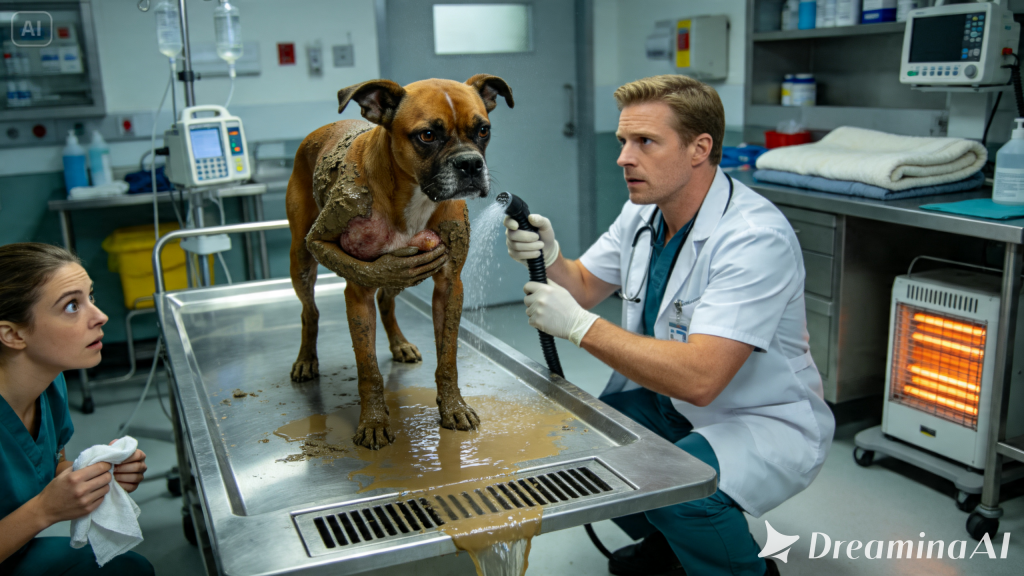
The rain wasn’t just falling; it was a violent, sideways sheet of freezing water that felt like needles against my face.
I’ve been an emergency veterinarian in this county for twelve years.
I thought I had seen the absolute worst of what nature, accidents, and human cruelty could do to an animal.
I was wrong.
It was a Tuesday evening, right in the middle of one of the worst flash flood warnings our town had seen in a decade.
The sky was a bruised, ugly purple, and the wind was howling through the trees, snapping branches and tossing debris across the flooded roads.
My clinic was running on a skeleton crew.
Just me and my lead technician, Sarah, trying to keep up with the chaos of storm-related emergencies.
The phone rang at exactly 6:14 PM.
It was animal control.
They were completely overwhelmed with calls across the county, dealing with downed power lines and stray livestock.
The dispatcher’s voice was frantic, barely audible over the static and the sound of my own roof rattling.
“Doc, we’ve got a civilian report of a dog trapped in the old Miller development lot. The whole area is flooding. We can’t get a truck out there for at least three hours.”
Three hours in this weather was a death sentence.
I didn’t even think. I just grabbed my heavy slicker coat, my emergency medical bag, and my keys.
“Sarah, prep the trauma bay,” I shouted over the wind as I shoved the clinic door open. “Keep the heating blankets on high. I’m going out.”
The drive to the Miller lot was a nightmare.
My truck’s tires spun and hydroplaned on the back roads, the headlights cutting through the torrential downpour but barely illuminating ten feet ahead of me.
The Miller lot was an abandoned construction site, a massive expanse of uneven dirt, deep trenches, and rusted rebar, completely forgotten by the developers when the funding dried up.
Now, it was a massive, churning mud pit.
I parked my truck on the shoulder, the hazard lights flashing, casting eerie yellow shadows across the rising water.
I stepped out, immediately sinking ankle-deep into the freezing, thick sludge.
The cold bit right through my boots.
I grabbed my heavy-duty flashlight and began sweeping the beam across the desolate landscape.
The rain was deafening. I couldn’t hear anything besides the crashing water and the wind.
“Hello!” I screamed, feeling ridiculous, hoping against hope that the dog was somewhere visible.
I waded deeper into the lot, the mud sucking at my boots, threatening to pull me under with every step.
My flashlight beam bounced off a rusted metal shipping container sitting at a slight angle near the back of the property.
And then, I saw her.
Tucked into a small, rapidly flooding muddy alcove beneath the edge of the container was a dog.
She was a Boxer, or at least, I assumed she was beneath the suffocating layer of mud and debris covering her entire body.
She was shivering so violently that her teeth were audibly chattering, a sickening, rhythmic clicking sound that cut through the storm.
I froze, lowering my flashlight slightly so I wouldn’t blind her.
“Hey, sweetheart,” I called out, forcing my voice to be as calm and gentle as possible despite my racing heart.
She didn’t wag her tail. She didn’t look at me with hope.
Instead, she flattened her ears against her skull and let out a low, guttural growl that vibrated in her chest.
It wasn’t a growl of aggression. It was a growl of pure, unadulterated terror.
I took a slow step forward.
The moment my boot squelched in the mud, she scrambled backward, pressing her spine against the cold metal of the shipping container.
But it was how she moved that made my blood run cold.
She didn’t stand up. She dragged herself.
Her right front leg and part of her chest were entirely plastered in a thick, cement-like crust of dark mud.
But she was aggressively curling her body, hiding her right side, tucking her leg so tightly under her swollen belly that it looked grotesque, unnatural.
Every time she shifted, she let out a sharp, agonizing whimper that tore at my heart.
“You’re hurt,” I whispered, dropping to my knees right there in the freezing mud, ignoring the water seeping into my scrubs.
I slowly reached into my bag and pulled out a slip lead.
I needed to secure her before the water rose any higher. The alcove was already filling up.
“I’m not going to hurt you,” I cooed, inching forward on my knees.
She locked eyes with me. Her eyes were wide, bloodshot, and filled with a desperate, wild panic.
As I extended my hand, she lunged.
Her jaws snapped the air just inches from my wrist.
I recoiled, shocked by the sudden burst of energy from an animal that looked half-dead.
But as soon as she lunged, she screamed—a horrific, high-pitched yelp of pain—and immediately collapsed back onto her side, aggressively curling around that hidden, swollen mass under her belly again.
She was protecting it.
She was protecting her leg, her stomach, whatever was hidden beneath that hardened shell of mud, with her literal life.
I didn’t have time for patience. The water was now swirling around her paws.
I took off my heavy slicker coat, the freezing rain instantly soaking through my shirt.
I threw the coat over her like a net.
She thrashed wildly beneath the heavy fabric, her screams muffled but no less agonizing.
I wrapped my arms around the bundle, feeling her skeletal frame beneath the coat, but also feeling an unnatural, hard, swollen mass on her side.
It felt wrong. It didn’t feel like a normal broken bone.
It felt jagged, wide, and heavily inflamed.
“I got you, I got you,” I grunted, lifting her into my arms.
She was surprisingly heavy, the thick mud adding pounds to her starved frame.
I stumbled back through the mud pit, nearly falling twice, my muscles burning as I carried her to the truck.
I shoved her into the heated cab, slamming the door against the storm.
The drive back to the clinic was a blur of adrenaline and anxiety.
She lay on the passenger floorboard, wrapped in my coat, hyperventilating.
Every time I hit a bump, she whimpered, and her body seized up, curling tighter around that hidden, swollen joint.
I couldn’t stop looking down at her.
What had happened to her? Was it a car strike? Did she fall into the trench?
The swelling was massive. It looked like a tumor, or a compound fracture that had become severely infected and encased in mud.
I pulled into the clinic parking lot, honking the horn.
Sarah was already at the doors, pulling them open as I rushed in with the heavy, muddy bundle in my arms.
“Oh my god, the smell,” Sarah choked out as we rushed down the hallway.
She was right. The smell was overpowering.
It wasn’t just wet dog and swamp mud. It was the distinct, metallic scent of blood and something deeply necrotic.
“Trauma table, now,” I barked, laying the coat down gently on the stainless steel surface.
Under the harsh fluorescent lights of the clinic, she looked even worse.
She was a Boxer, maybe four or five years old, severely emaciated.
But her entire right side, from her shoulder down to her underbelly, was encased in a solid block of dried, crusty mud, tangled with weeds and debris.
And she still refused to let us see it.
Even on the slippery metal table, she twisted her spine, pinning that side down, growling whenever Sarah stepped too close.
“Doc, she’s shivering too hard, her temperature is plummeting,” Sarah said, her voice shaking as she tried to get a thermometer in. “We need to get this freezing mud off her now, or she’s going to go into shock.”
“We can’t just pull it off, it’s bonded to the skin. It might be acting as a tourniquet if there’s a severe laceration beneath it,” I explained, my mind racing.
“Bring the portable warm water hose. We have to melt it off. Slowly.”
Sarah rushed to get the heated hose from the grooming bay.
I stood over the dog, speaking softly, trying to pry her chin up so she would look at me.
“It’s okay. You’re safe now,” I murmured.
She stared up at me, her eyes tracking every microscopic movement of my hands.
Her breathing was incredibly shallow. Too fast. Too panicked.
Sarah returned, the hose dripping warm water.
“Okay, let’s start at the shoulders and work our way down to the mass,” I instructed.
I snapped on a pair of heavy rubber examination gloves.
I took the hose, testing the temperature on my wrist. It was perfectly warm.
I aimed the gentle spray at the back of her neck.
Minute one.
The water hit the mud, and instantly, a thick, black sludge began to pool on the metal table, spiraling toward the drain.
The dog tensed, letting out a sharp whine, but the warmth seemed to slightly ease her shivering.
“That’s a good girl,” Sarah whispered, gently holding the dog’s head, keeping her steady.
Minute three.
The mud was incredibly stubborn. It was like clay, baked onto her fur.
I had to use my fingers to gently massage the warm water into the crust, breaking it apart chunk by chunk.
As I moved down her chest, the smell grew worse.
It was pungent, making my eyes water.
“Her heart rate is through the roof, Doc,” Sarah warned, keeping her fingers pressed to the dog’s femoral artery on her good leg.
Minute five.
We had cleared her front left leg and her chest.
She was horribly skinny, her ribs jutting out against her skin.
But I was dreading what came next. The mass. The swollen, hidden right leg and belly.
“I have to roll her slightly, Sarah. Hold her steady.”
I gently pressed my hands against her spine, carefully tilting her to expose the hardened, muddy lump she had been defending so fiercely.
She fought me.
She thrashed, a weak but desperate struggle, snapping her teeth in the direction of the hose.
“No, no, no, hey, it’s okay!” I commanded, firmly but gently pinning her shoulder to keep her from hurting herself.
The mass was huge. It was the size of a grapefruit, completely encased in dark, tangled mud.
Minute seven.
I focused the warm water directly onto the hardened shell.
The water ran brown, then dark red.
Blood.
“We’ve got active bleeding,” I said, my chest tightening. “Prep the gauze and the coagulant. It might be an open fracture.”
I continued to spray, my fingers gently working away the debris.
The mud was thickest here, intertwined with something fibrous.
I couldn’t feel bone.
I pressed my thumbs lightly against the mass through the mud.
It was soft. Spongy.
It wasn’t a tumor. It wasn’t a bone.
Minute eight.
The dog let out a sound I had never heard in my twelve years of practice.
It wasn’t a whimper or a growl. It was a deep, mournful wail, a sound of absolute, devastating surrender.
She stopped fighting. Her head dropped heavily onto the metal table, her eyes wide, staring blankly at the wall.
“Doc… look,” Sarah gasped, taking a step back from the table.
Minute nine.
The final, heavy chunk of mud slid away beneath the stream of the warm water, washing down the metal drain.
The water suddenly ran perfectly clear.
I looked down at the swollen mass on her leg and underbelly.
My breath hitched in my throat.
The spray nozzle slipped from my hand, clattering loudly against the stainless steel table.
My hands began to shake uncontrollably.
I stumbled backward, my heart slamming against my ribs, an icy wave of pure dread and disbelief washing over my entire body.
Because what was hiding underneath all that mud… wasn’t a broken leg at all.
CHAPTER 2
I stood there, completely paralyzed, the heavy rubber hose swinging wildly from the edge of the metal table, spraying warm water across my boots.
Sarah let out a sound that I will never forget for as long as I live.
It was a choked, breathless gasp, followed by her instantly clamping both of her hands over her mouth, her eyes wide with unadulterated horror.
Underneath that hardened shell of black mud and debris, pressed tightly against the Boxer’s inflamed, milk-swollen teats…
Was a human baby.
It was impossibly small. Maybe three or four weeks old, at the absolute most.
The infant was wrapped tightly in a filthy, saturated piece of what looked like a faded yellow flannel shirt.
Advertisement
The dog hadn’t been nursing a massive tumor.
She hadn’t been fiercely hiding a shattered bone or a feral trap.
She had deliberately rolled herself in the thick, freezing clay of the construction site.
She had used the heavy mud, the surrounding debris, and her own failing body heat to create a waterproof, insulated cocoon.
She had literally buried herself alive to keep this child from freezing to death in the flash flood.
“Doc…” Sarah whispered, her voice trembling so hard it fractured in the quiet room. “Is it… is it alive?”
I couldn’t move for a fraction of a second.
My brain simply refused to process the data my eyes were sending it.
I am a veterinarian. I fix shattered femurs on golden retrievers. I treat feline leukemia and perform routine spays.
I do not practice human medicine.
I ripped off my heavy rubber gloves, throwing them to the wet floor with a wet slap.
My bare hands were shaking uncontrollably as I reached toward the tiny bundle.
The Boxer tensed immediately.
A deep, rumbling growl started deep in her chest, vibrating loudly against the stainless steel table.
She lifted her heavy, exhausted head and bared her teeth, her eyes wide with a terrifying, primal warning.
She was starving, half-dead from hypothermia, and physically broken.
But she was fully prepared to tear my throat out to protect this infant.
“It’s okay,” I stammered, my voice cracking under the pressure. “I’m not going to hurt your baby. I promise.”
I kept my hands highly visible, moving with excruciating slowness.
I gently placed two fingers against the tiny, exposed purple neck of the infant.
Nothing.
My stomach dropped into a bottomless void.
Then, a faint, erratic flutter pushed against my fingertips.
“We have a pulse!” I yelled, the sudden volume of my own voice startling me. “It’s weak, it’s incredibly thready, but it’s there!”
The dog seemed to understand the drastic shift in my tone.
Her low growl faltered.
She let out a pathetic, high-pitched whine and gently nudged the flannel bundle with her wet nose.
She looked up at me, the aggressive glare completely replaced by a look of sheer, desperate pleading.
She was passing the baton. She couldn’t save the child anymore.
She needed me to do it.
“Sarah, get the pediatric oxygen mask. Now!” I ordered.
“Doc, we can’t—that’s for puppies, we don’t have human gear!” she cried out, frozen in place.
“Lungs are lungs, Sarah! Move!” I roared, completely losing my professional composure.
She sprinted toward the surgical suite, her boots slipping violently on the wet tile floor.
I carefully slid my hands under the filthy flannel shirt, lifting the baby away from the dog.
The infant weighed practically nothing. Maybe five pounds.
The baby’s skin was an alarming, mottled shade of blue and gray.
The tiny lips were completely colorless.
The dog whimpered as I took the child away, trying to stand up to follow me, but her back legs completely gave out.
She collapsed back onto the metal table, panting heavily, her bloodshot eyes locked onto the bundle in my arms.
“Stay with her!” I yelled over my shoulder to the empty room, rushing toward the primary trauma bay.
I laid the infant on a heated surgical table, frantically peeling away the soaked flannel.
The baby was wearing absolutely nothing but a soiled, oversized cloth diaper.
The tiny chest was barely rising. Hypothermia was actively shutting down the infant’s fragile organs.
Sarah skidded into the room, holding the tiny, clear plastic oxygen mask we usually used for newborn kittens and toy breeds.
I cranked the oxygen flow, holding the mask gently over the baby’s nose and mouth.
“Get the forced-air warming blanket. Set it to maximum heat,” I ordered, my hands moving on pure muscle memory.
Sarah fumbled with the bulky machine, her hands shaking so violently she dropped the hose twice.
“Call 911. Tell them we have a human infant in critical condition. Tell them to send life flight if the helicopters can fly in this storm.”
Sarah grabbed the clinic’s emergency landline from the wall.
She dialed, her face pale, staring relentlessly at the blue infant on the table.
“It’s dead… the line is dead,” she gasped, slamming the receiver down.
The storm had completely taken out the local telecom lines. We were completely cut off from the grid.
“Use your cell!”
“No service,” she cried, holding up her phone frantically. “The tower on Ridge Road must be down.”
I cursed loudly, a string of heavy profanities that I rarely used in front of my staff.
We were completely trapped.
Just me, a terrified vet tech, a dying dog, and a freezing human baby.
I started gently massaging the infant’s chest, trying to manually stimulate blood flow, praying I wouldn’t snap the fragile ribs.
The wind howled violently against the clinic windows, rattling the thick glass in its frames.
Then, the lights flickered.
Once. Twice.
And plunged us into absolute, suffocating darkness.
The backup generator violently kicked on ten seconds later, bathing the trauma bay in a harsh, sickly yellow emergency light.
But the heavy medical equipment—the warming blanket, the electric heat monitors—didn’t restart.
“The generator doesn’t power the auxiliary outlets!” Sarah yelled over the loud hum of the diesel engine.
The forced-air warming blanket instantly deflated, turning cold in seconds.
The baby was losing heat again. Fast.
I looked around frantically. “Skin to skin,” I muttered.
“What?”
“Skin to skin contact! It’s the only way to transfer core body heat quickly.”
I didn’t hesitate for another second. I ripped open the front of my soaked scrub top.
I picked up the freezing, blue infant and pressed the tiny body directly against my bare chest.
The cold was shocking. It felt like holding a solid block of ice against my heart.
I grabbed a stack of dry, sterile surgical towels and wrapped them tightly around both of us, creating a makeshift thermal pocket.
“Doc, what about the dog?” Sarah asked, her voice cracking with suppressed tears.
I looked back through the open doorway into the wet room.
The Boxer was lying exactly where I left her.
She wasn’t looking at us anymore. Her eyes were closed.
“Go check her gums. Check her capillary refill time,” I ordered, keeping the oxygen tube pressed near the baby’s face.
Sarah rushed over to the metal table.
“They’re white, Doc. Pale white. She’s bleeding internally, or her organs are completely shutting down from the cold.”
We were losing both of them.
I had to make a horrific choice.
I couldn’t operate on a dying dog while holding a dying human infant to my chest.
“Start an IV of warm lactated Ringer’s on the dog,” I instructed rapidly. “Give her a dose of broad-spectrum antibiotics and heavy pain meds. That’s literally all we can do right now.”
Suddenly, a massive boom shook the front of the clinic.
It sounded like a truck had aggressively rammed into the waiting room doors.
Sarah screamed, dropping the IV line onto the floor.
“Hello?!” a deep, aggressive voice echoed loudly from the front lobby. “Anyone in here?!”
It was accompanied by the terrifying sound of heavy boots stomping quickly on the tile.
“Back here!” I yelled, a massive wave of relief washing over me.
Maybe the phone line had gone through for a split second. Maybe a passing patrol car had seen my hazard lights earlier.
A man burst through the swinging double doors of the treatment area.
He was a county sheriff’s deputy, soaked to the bone, his yellow reflective raincoat dripping massive puddles onto the floor.
His eyes darted wildly around the chaotic, blood-stained scene.
He saw Sarah crying hysterically. He saw the dark blood and thick mud smeared across the sterile floor.
He saw me, shirtless, clutching a tiny, towel-wrapped bundle to my chest, holding an oxygen tube.
And then, he saw the dog.
The Boxer, despite being on death’s door, reacted violently to the aggressive entrance of a strange man.
Her powerful maternal instincts fired back up instantly.
She forced her front legs underneath her, attempting to stand on the slippery metal.
She let out a vicious, blood-curdling snarl, her hackles raised aggressively, staring dead at the deputy.
The deputy didn’t see a hero.
He saw a large, powerful breed known for aggression, covered in fresh blood, growling at him in a room with a desperate doctor and an injured infant.
He immediately drew his service weapon.
“Get back!” he bellowed, leveling the heavy black pistol directly at the Boxer’s head.
“No!” Sarah shrieked, throwing both of her hands over her ears.
“Stop! Put the gun down!” I screamed, turning my body to shield the baby but refusing to step away from the dog.
“Doc, step away from the animal!” the deputy yelled, his finger hovering dangerously near the trigger. “That’s the dog from the Miller lot! Dispatch said it was a stray—it looks rabid!”
“She’s not rabid! She saved the baby!” I roared, my voice echoing violently off the tile walls.
“She’s covered in blood, and she’s highly aggressive! Step away, now!”
The dog barked—a harsh, wet, ragged sound—and staggered a step forward.
She physically put her own broken body between the deputy and where I was standing with the infant.
She was actively trying to protect the baby from the man with the gun.
The deputy’s stance widened. He tightened his grip on the weapon, his knuckles turning white.
“I’m putting it down!”
“If you shoot that dog, you’ll have to shoot me first!” I yelled, making a split-second, incredibly stupid decision.
I stepped directly into the line of fire, clutching the freezing infant tightly to my chest.
The deputy flinched hard, instinctively lowering the muzzle slightly. “Doc, are you insane?!”
“Listen to me!” I said, my voice dropping to a harsh, deadly serious register.
“Look at the mud on the table. Look at her underbelly.”
The deputy kept his gun drawn but allowed his eyes to flick toward the metal table.
“She didn’t attack this child,” I said, gasping for breath as the adrenaline heavily spiked my heart rate.
“She incubated it. She hid it under her own body in the freezing mud to stop it from freezing to death.”
The deputy stared at me, then down at the shivering, pathetic animal still trying to valiantly stand her ground.
“Where did the baby come from?” the deputy asked, his voice shaking violently now.
“I don’t know,” I said truthfully.
“Dispatch didn’t send me here for a stray dog,” the deputy said, his face completely draining of color.
He slowly holstered his weapon, his eyes wide with a sudden, horrifying realization.
“I came here because… a frantic woman just ran into the precinct.”
He looked at the baby in my arms, and then back at the blood-soaked dog.
“Her ex-husband stole her car an hour ago,” the deputy whispered, the roaring sound of the storm outside seemingly fading into the background.
“With her newborn baby inside.”
I felt the blood physically freeze in my veins.
“They found the car abandoned half a mile from the Miller lot,” he continued, taking a slow, hesitant step forward. “It had rolled off the embankment into the deep drainage ditch.”
He pointed a trembling finger at the fading yellow flannel shirt lying in the biological waste bin.
“The mother told us the baby was wrapped in a yellow shirt.”
The dog, sensing the immediate threat was over, finally lost her brutal battle with gravity.
She collapsed heavily onto the metal table, her eyes rolling back into her head, a horrific rattling sound coming from her chest.
“We need a medic, now!” I screamed.
“The roads are completely washed out. Nobody is getting in or out of this entire side of town,” the deputy said, pulling out his shoulder radio. “We are entirely on our own.”
I looked down at the tiny, fragile life pressed against my bare chest.
Advertisement
The baby was still blue. Still freezing.
And the dog who had literally traded her life for this child’s was currently bleeding out on my table.
I had to figure out a way to save them both.
But as I slightly shifted my grip to check the infant’s fragile airway, something hard and sharp dug into my bare skin.
It was tucked deep inside the thick folds of the baby’s oversized diaper, hidden completely from view until now.
I carefully pulled it out with two trembling fingers.
It was a small, incredibly heavy piece of metal, attached to a thick, torn leather strap.
The deputy stepped closer, shining his tactical flashlight directly onto the object resting in my palm.
We both stared at it, a sickening, suffocating silence filling the chaotic room.
It wasn’t a baby toy. It wasn’t a medical bracelet.
It was a man’s heavy silver watch, the glass face shattered, completely covered in dark, fresh blood.
And it definitively proved that the dog hadn’t just stumbled upon this abandoned baby in the mud.
She had violently taken it from someone.
CHAPTER 3
I stared at the heavy silver watch resting in my palm, the shattered glass face cutting into my skin.
The dark, tacky blood coating the metal was still fresh enough to smear across my thumb.
The room was perfectly silent except for the harsh, erratic howling of the wind outside and the low, throbbing hum of the diesel backup generator.
The deputy took a slow, hesitant step closer, his tactical flashlight illuminating the object in my hand.
He didn’t say a word, but I could hear his breathing hitch.
“This didn’t come from the mud,” I whispered, my voice completely hollow. “It was tucked deep inside the diaper. Purposefully.”
The deputy reached out with a trembling, gloved hand and gently took the watch from my palm.
He flipped it over, his flashlight beam catching the polished silver on the back of the casing.
There was an engraving.
“To Marcus. Our forever. 2021,” the deputy read aloud, his voice dropping to a gravelly, terrified whisper.
He looked up at me, his eyes wide and stripped of all their previous authority.
Advertisement
“The mother… the frantic woman at the precinct,” he stammered. “She said her ex-husband’s name was Marcus.”
My stomach violently plummeted, a sickening rush of pure adrenaline flooding my system.
“He was wearing this,” I said, looking down at the massive, blood-soaked Boxer bleeding out on my metal table.
I looked back at the tiny, freezing baby pressed against my bare chest.
“She didn’t just find this baby in the storm,” I said, the horrifying reality finally snapping into perfect focus.
“She took the baby from him.”
The deputy’s face turned ash white in the sickly yellow emergency lighting.
“The car rolled into the drainage ditch,” the deputy muttered, piecing the nightmare together in real-time. “The ditch feeds directly into the spillway behind the Miller development.”
He looked at the shattered glass of the watch, then at the blood.
“He wasn’t trying to save the child,” the deputy said, his hand dropping to the grip of his holstered weapon. “He was trying to drown it in the floodwaters.”
Before I could process the sheer, unadulterated evil of that statement, the tiny bundle against my chest suddenly went completely rigid.
The baby wasn’t shivering anymore.
“Sarah!” I screamed, the pure panic in my voice tearing through the room.
Sarah abandoned the IV line she was prepping for the dog and sprinted back over to me.
“The baby stopped breathing,” I gasped, peeling the sterile surgical towels back.
The infant’s mottled blue skin had turned a horrifying shade of slate gray.
The tiny chest, which had been rising with shallow, erratic breaths just moments ago, was completely still.
“Oh god, oh god,” Sarah panicked, grabbing the pediatric stethoscope and pressing it to the infant’s chest.
“I don’t hear a heartbeat, Doc. I don’t hear anything!”
I didn’t have time to think. I didn’t have time to remember I wasn’t a human doctor.
Lungs are lungs. A heart is a heart.
I laid the infant flat on the closest examination table, sweeping the bloody watch and the oxygen mask out of the way.
“Start bagging!” I ordered Sarah, shoving the tiny clear plastic mask back into her hands.
She attached the manual ambu-bag to the oxygen line, placing the mask tightly over the baby’s nose and mouth.
I placed two fingers directly over the center of the infant’s fragile sternum.
“Starting compressions,” I said, my voice shaking so hard I barely recognized it.
One. Two. Three. Four.
I pressed down, terrified that I was going to snap the tiny ribs beneath my fingers.
The baby felt like a porcelain doll. So incredibly fragile. So completely defenseless.
“Squeeze,” I commanded.
Sarah squeezed the ambu-bag, forcing oxygen into the tiny, failing lungs.
The baby’s chest rose and fell artificially.
“Again. One, two, three, four… squeeze.”
The deputy stood frozen in the corner of the room, his hand still resting on his gun, utterly useless in the face of this medical terror.
“Come on, little one. Come on, don’t do this,” I pleaded, sweat stinging my eyes.
“You survived a flash flood. You survived a monster. You don’t get to die on my table!”
Minute one passed.
Nothing. The baby remained a horrifying, lifeless gray.
Minute two.
My fingers were cramping, but I didn’t stop. I couldn’t stop.
I thought about the Boxer on the other table, literally draining her own lifeblood to protect this child.
She had sacrificed everything. I was not going to let her sacrifice be for absolutely nothing.
“Doc, the dog!” Sarah shrieked, her eyes darting over my shoulder.
I couldn’t look away from the baby. “What is it?!”
“She’s seizing! Her temperature is too low, she’s going into full hypovolemic shock!”
We were losing them both. At the exact same time.
The universe was pulling them down into the dark, and I was just one man trying to hold back the tide.
“I can’t stop compressions!” I yelled. “Deputy! I need you!”
The deputy snapped out of his shock, rushing forward. “What do you need?”
“I need you to hold this baby. Skin to skin. Right now.”
The deputy didn’t hesitate.
He ripped off his heavy, soaked reflective raincoat, tossing it to the floor.
He tore open the buttons of his uniform shirt, exposing his chest.
“Take over compressions for three seconds while I transfer,” I ordered.
I gently scooped the lifeless infant into my hands, instantly pressing the tiny body against the deputy’s warm chest.
“Wrap the towels around both of you,” I said, my hands already moving back to the ambu-bag. “Keep bagging, Sarah!”
I spun around and sprinted toward the surgical table where the Boxer was thrashing violently.
Her heavy body was slamming against the stainless steel, her teeth clacking together in a terrifying rhythm.
Blood was pooling rapidly beneath her right side—the side that had been encased in mud.
“Hold her head! Don’t let her crack her skull!” I shouted, grabbing a thick towel and wedging it under her neck.
I grabbed the heavy electric clippers from the overhead tray.
The power was out, but the clippers were fully charged on battery backup.
“I need to find the source of this bleed,” I said, turning the clippers on.
I pressed the vibrating blades into the thick, matted fur on her right flank, right where the massive swelling was.
The fur peeled away in thick, muddy strips.
What I saw underneath made me physically gag.
It wasn’t a broken bone piercing the skin.
It wasn’t a laceration from sharp debris in the floodwaters.
It was a perfectly straight, incredibly deep puncture wound.
“That’s a knife wound,” the deputy said from behind me, his voice trembling as he clutched the baby to his chest.
“A wide-blade hunting knife. He stabbed her.”
The room spun.
The dog hadn’t just shielded the baby from the cold.
She had physically intercepted a man armed with a knife who was trying to murder his own child.
She had taken the blade meant for the infant.
And then, she had fought back.
She had clamped her powerful jaws around his wrist, shattering his watch, tearing his flesh, and forcing him to drop the baby.
She had dragged the infant away into the mud, burying them both to hide from him in the dark.
“I need surgical staples, stat!” I yelled, pressing a massive wad of sterile gauze directly into the gaping wound.
The dog let out a weak, pathetic whine, her seizure finally breaking as her body went completely limp.
“Her heart rate is dropping, Doc. She’s slipping away,” Sarah cried, handing me the staple gun.
I pressed the edges of the jagged wound together, my hands coated in her blood.
Clack. Clack. Clack.
I fired six heavy surgical staples into her flesh, desperately trying to close the artery.
“Push a massive dose of epinephrine and start a plasma transfusion if we have any left in the cooler!” I barked.
Suddenly, a sound pierced the chaotic noise of the room.
It was faint. It was incredibly weak.
But it was unmistakable.
A tiny, raspy, high-pitched cry.
I whipped my head around.
The deputy was staring down at his chest, tears freely streaming down his hardened face.
The baby’s chest was rising on its own.
The lips were turning from gray to a faint, beautiful shade of pink.
“He’s breathing,” the deputy choked out, his voice cracking. “The kid is breathing.”
A massive wave of dizzying relief washed over me, so intense my knees actually buckled for a fraction of a second.
Sarah let out a loud, shuddering sob, covering her face with her bloody hands.
“Keep the oxygen near his face,” I instructed, turning back to the dog.
“You hear that, girl?” I whispered to the unconscious Boxer, gently stroking her ears. “He’s alive. You did it.”
But the dog didn’t respond.
Her chest was barely rising. Her gums were still paper-white.
The staples had stopped the external bleeding, but the internal damage was severe.
“We need a surgeon, a real veterinary surgeon with an operating room,” I said, my voice thick with despair.
“We are totally isolated,” the deputy reminded me softly. “The roads are rivers.”
As if to punctuate his point, a massive crack of thunder shook the entire building, rattling the surgical instruments on their metal trays.
And then, the deputy’s shoulder radio suddenly burst into life.
It was pure static at first, a harsh, grating hiss that filled the room.
But then, a frantic, broken voice broke through the interference.
“…Dispatch to unit four… do you copy… repeat, unit four…”
The deputy practically ripped the radio from his shoulder strap.
“This is unit four, I read you, dispatch! Barely, but I read you!”
“…be advised… suspect Marcus Thorne… confirmed armed and highly dangerous…”
The static flared up again, drowning out the dispatcher’s voice.
“Dispatch, repeat! What is his location?!” the deputy yelled into the mic.
“…stolen vehicle abandoned on Highway 9… suspect is on foot… tracking dogs lost the scent in the water…”
My blood ran completely cold.
Highway 9.
The clinic was on the corner of Highway 9 and Elm.
“…civilian report of a man walking south… heading toward the only visible lights…”
The radio crackled violently and went completely dead.
The deputy slowly lowered the radio, his eyes locking onto mine across the trauma bay.
The backup generator.
The heavy, throbbing diesel engine was roaring outside our back door.
In a massive, sprawling county entirely plunged into total blackout by the storm, our clinic was the only building for miles with any electricity.
We were a massive, glowing beacon in the pitch-black night.
“Turn off the lights,” the deputy whispered, his voice deadly serious.
“What?” Sarah asked, freezing in place holding a bag of IV fluids.
“Turn off the damn lights, right now!” he roared, drawing his weapon again with his free hand while still clutching the baby to his chest.
Advertisement
I lunged for the wall panel, slamming my fist against the main breaker for the generator lights.
The entire clinic plunged into absolute, suffocating darkness.
The only illumination was the faint, eerie glow of the emergency exit signs over the doors.
“Is he coming here?” Sarah whimpered, completely terrified in the dark.
“He lost the baby in the mud,” the deputy whispered, moving slowly toward the hallway.
“He knows he’s going to prison for the rest of his life if that child is found alive. He’s hunting them.”
I stood perfectly still in the dark, my hands still resting gently on the unconscious dog on the table.
I couldn’t see my own hand in front of my face.
But I could hear the wind. I could hear the rain lashing against the glass storefront.
And then, I heard something else.
It wasn’t the storm.
It was a heavy, metallic thud.
It came from the front of the clinic.
Someone was yanking aggressively on the locked front doors of the waiting room.
My heart slammed against my ribs so hard it physically hurt.
The handle rattled violently, the sound echoing down the long, dark hallway toward the trauma bay.
“Get in the surgical supply closet,” the deputy ordered in a harsh whisper. “Both of you. Take the dog, take the baby. Barricade the door.”
“I can’t move the dog, she’s critical!” I whispered back frantically.
“If that man gets in here with a hunting knife, we are all dead!” the deputy hissed.
The rattling at the front door suddenly stopped.
There was a moment of agonizing silence.
Then, a massive, deafening crash shattered the night.
The heavy, reinforced glass of the clinic’s front doors absolutely exploded inward, the sound of breaking glass raining across the tile floor.
Someone had just smashed their way inside.
Heavy, wet boots crunched slowly over the broken glass in the lobby.
“Sarah, take the baby,” the deputy whispered, pressing the tiny bundle into her shaking arms.
“Go to the back room. Lock the steel security door.”
Sarah took the baby, tears streaming down her face, and silently vanished into the shadows of the back hallway.
The deputy raised his weapon, stepping out of the trauma bay and into the dark corridor, aiming toward the lobby.
“Sheriff’s department!” he bellowed, his voice echoing loudly. “Drop your weapon and put your hands on your head!”
The heavy footsteps stopped immediately.
There was no answer. Just the sound of the wind howling through the shattered front doors.
I stood frozen next to the surgical table, clutching a heavy metal scalpel in my right hand.
I was terrified. I was just a vet. I had absolutely no idea how to fight an armed killer in the dark.
But I looked down at the massive Boxer bleeding on my table.
She had fought him. She had almost died to protect that child.
I wasn’t going to let him finish the job.
“I said drop it!” the deputy yelled again, taking a slow step down the hallway.
Suddenly, a flashlight beam cut fiercely through the darkness from the lobby, blinding the deputy instantly.
A loud, metallic click echoed from the front room.
It wasn’t the sound of a knife.
It was the unmistakable sound of a heavy caliber handgun racking a round into the chamber.
“Where is my kid?” a deep, ragged voice demanded from behind the blinding light.
The deputy didn’t hesitate. He fired a warning shot into the ceiling, the deafening BANG ringing in my ears.
The man in the lobby fired back.
The bullet slammed into the drywall just inches from the deputy’s head, showering the hallway in white dust.
The deputy threw himself backward into the trauma bay, knocking over a tray of surgical instruments with a massive crash.
“He’s got a gun!” the deputy yelled, scrambling to his feet in the dark.
We were trapped.
There was no back exit from the trauma bay. The only way out was through the hallway, directly into the line of fire.
The heavy, wet footsteps started moving down the hallway, slow and methodical.
“I know you have the dog,” the man’s voice echoed, dripping with pure malice.
“I tracked the blood from the ditch. Hand over the kid, and maybe I let you live.”
The flashlight beam swept slowly across the hallway walls, getting closer and closer to the open doorway of our room.
I tightened my grip on the scalpel, my palms sweating profusely.
The deputy leveled his gun at the doorway, his breathing ragged.
The beam of light hit the doorframe.
The man stepped into the threshold, his gun raised, his face twisted in a mask of pure rage.
He aimed his weapon directly at the deputy’s chest.
But before either of them could pull the trigger, something completely impossible happened.
Something that defied every medical law I had ever learned in my twelve years of practice.
CHAPTER 4
I had my fingers pressed against the Boxer’s femoral artery just seconds before the man walked into the room.
There was no pulse.
Her core temperature had plummeted so low it wasn’t registering on our analog emergency thermometer.
She had lost roughly forty percent of her total blood volume.
By every metric of veterinary medicine, biology, and basic physics, the dog lying on my surgical table was clinically dead.
Her brain simply hadn’t sent the final eviction notice to her body yet.
But as the man stepped into the doorway, racking the slide of his handgun and aiming it directly at the deputy’s chest, the impossible happened.
The dog didn’t just wake up.
She didn’t just twitch.
Her eyes snapped open, blazing with an unnatural, terrifying clarity in the ambient glow of the deputy’s dropped flashlight.
She didn’t whine. She didn’t growl.
She simply exploded.
With her back legs completely useless, her internal organs failing, and six massive metal staples barely holding her torn flesh together, she launched herself entirely with her front shoulders.
She flew off the slick stainless steel table, a sixty-pound missile of pure, unadulterated maternal fury.
Marcus didn’t even have time to blink.
The dog slammed directly into his chest, her massive jaws clamping down viciously on his right forearm, right over the spot where she had already torn his flesh down at the floodway.
The impact knocked him violently backward.
The gun went off.
The muzzle flash illuminated the dark hallway in a blinding, instantaneous strobe of yellow and white.
The deafening crack of the gunshot echoed off the tile walls, completely blowing out my eardrums.
I felt the physical heat of the bullet as it zipped past my shoulder, missing me by absolute fractions of an inch, before burying itself deep into the clinic’s drywall.
Marcus hit the floor hard, screaming in a mixture of shock and sheer agony.
The dog didn’t let go.
She violently thrashed her head, tearing at his gun arm with every ounce of fading strength she had left in her shattered body.
“Drop it! Drop the gun!” the deputy roared, recovering from his defensive flinch instantly.
He didn’t fire his own weapon. He couldn’t.
In the chaotic, thrashing shadows, he couldn’t risk hitting the dog.
Instead, the deputy launched himself forward.
He tackled Marcus, driving his knee directly into the man’s ribs with a sickening crunch that I could hear even over the ringing in my ears.
Marcus screamed again, dropping the heavy handgun.
It skittered across the bloody tile, spinning toward my feet.
Advertisement
I didn’t think. I kicked it as hard as I could.
The weapon slid completely under the heavy metal surgical cabinets, completely out of reach.
“Hands behind your back! Give me your hands!” the deputy bellowed, wrestling the massive, violently struggling man onto his stomach.
But Marcus was fighting with the chaotic, adrenaline-fueled strength of a cornered animal.
He threw a brutal elbow backward, catching the deputy squarely in the jaw.
The deputy’s head snapped back, his grip loosening for a fraction of a second.
Marcus tried to push himself up, his eyes wide and completely deranged in the flashlight beam.
But the Boxer wasn’t finished.
She dragged her broken body up Marcus’s side, planting her front paws directly on his throat, pinning him to the cold, wet tile.
She lowered her massive head, her teeth bared just millimeters from his face.
She let out a low, guttural, demonic growl that vibrated through the floorboards.
It was a promise.
Move, and I will rip your throat out.
Marcus froze. The sheer terror in his eyes finally overrode his rage.
He stopped fighting.
The deputy capitalized instantly.
He slammed his full body weight back down on Marcus, ripping the man’s arms behind his back.
The harsh, metallic zip of heavy-duty flex cuffs filled the air.
“Suspect is secured,” the deputy gasped, rolling off Marcus and drawing his secondary taser, keeping it aimed squarely at the man’s chest.
“Doc. The dog.”
I snapped out of my paralytic shock.
I dropped to my knees beside the Boxer.
Her final act of defiance had completely drained her.
As soon as the threat was neutralized, her jaws went slack.
She slid off Marcus’s chest and collapsed onto the blood-slicked tile, her breathing turning into a wet, horrifying rattle.
Advertisement
The impact of her jump had completely torn open the surgical staples.
Fresh, bright arterial blood was violently pulsing from the knife wound on her side, pooling rapidly on the floor.
“Sarah! Sarah, come out! It’s safe!” I screamed at the top of my lungs.
The heavy steel security door at the back of the clinic clicked, and Sarah sprinted out, practically hyperventilating, still clutching the baby tightly to her chest.
“Put him in the incubator on battery power! Get over here and hold pressure!” I ordered.
We didn’t have time to lift the dog back onto the table.
I dropped to my stomach in the puddle of blood, ripping open a sterile pack of heavy-duty surgical clamps with my teeth.
“Flashlight! Shine it right here!” I yelled at the deputy.
The deputy kicked Marcus hard in the side, warning him to stay completely still, then rushed over, aiming his tactical beam directly into the gaping wound.
It was a total mess.
I had to dig my bare fingers blindly into the torn muscle tissue, desperately searching for the severed artery.
The blood was so slippery, so incredibly warm against my freezing skin.
“Come on, come on, where are you,” I muttered, sweat pouring down my face, stinging my eyes.
My fingers brushed against something pulsing rapidly.
“Got it!”
I clamped down hard, my thumb and index finger pinching the artery completely shut.
The violent spurting stopped instantly.
“I need a thick suture, a curved needle, and I need you to tie it off while I hold it,” I told Sarah.
Her hands were shaking violently. “Doc, I can’t see it, it’s too dark, the blood is too thick.”
“You don’t need to see it! You need to feel it!” I barked, grabbing her wrist and physically guiding her hand into the wound cavity.
“Right there. Loop it right under my thumb. Do it now, Sarah, or she dies on this floor.”
For the next ten minutes, we worked in absolute, terrifying silence, broken only by the raging storm outside and Marcus’s low groans of pain.
We tied off the artery. We packed the wound with heavily coagulated gauze.
We hooked her up to the last remaining bag of synthetic plasma we had in the entire clinic, holding the bag in the air manually because we didn’t have a stand.
And then, we waited.
We sat on the cold, bloody floor of that dark clinic for six agonizing hours.
The deputy kept his taser trained on Marcus the entire time, his jaw swelling massively from the elbow strike.
Sarah sat next to the battery-powered incubator, keeping her hand resting gently on the baby’s chest, monitoring the tiny, fragile heartbeat.
I sat with the dog’s heavy head resting in my lap.
I stroked her soft ears, wiping the thick, freezing mud from her face with a warm towel.
“You’re a good girl,” I whispered to her constantly. “You’re the best girl. Just hold on.”
Around 5:30 AM, the wind finally began to die down.
The heavy, violent rain slowed to a soft, rhythmic drizzle against the shattered front windows.
And then, faintly at first, I heard it.
The high-pitched, warbling wail of emergency sirens cutting through the morning fog.
The deputy stood up, his joints cracking loudly. “They finally cleared the roads.”
Ten minutes later, the clinic lobby was flooded with heavily armed SWAT officers, paramedics, and county sheriffs.
The harsh glare of their tactical lights sliced through the darkness, illuminating the absolute carnage of the trauma bay.
They dragged Marcus to his feet, forcefully shoving him out through the shattered glass doors toward a waiting squad car.
A team of paramedics instantly swarmed the incubator.
“Infant is stable, breathing spontaneously, core temp is rising,” a female paramedic called out, absolute disbelief in her voice. “It’s a miracle.”
“It’s not a miracle,” I said quietly, looking down at the massive dog in my lap. “It’s her.”
Two veterinary EMTs from the county emergency response team rushed in with a heavy transport gurney.
“We’ve got an emergency surgical suite prepped at the main county hospital,” one of them said, gently slipping a heavy canvas sling under the Boxer.
“Will she make it?” I asked, my voice cracking, suddenly feeling completely exhausted, as if gravity had tripled.
The EMT looked at her pale gums, the massive blood loss, the horrific knife wound.
He looked at me, a deep respect in his eyes. “If she survived the night, Doc, she’s not planning on dying today.”
As they lifted her onto the gurney, a sudden commotion erupted in the front lobby.
“Let me through! That’s my baby! Let me through!”
A woman’s voice, completely ragged, hysterical, and broken, echoed through the shattered doors.
A young woman, maybe twenty-five, drenched in rain, with dark circles under her eyes, shoved past two heavily armed deputies.
She sprinted into the back hallway, her eyes locking wildly onto the infant in the paramedic’s arms.
She collapsed to her knees right there on the bloody tile, sobbing so violently she couldn’t breathe.
“My baby… oh my god, my baby,” she wailed, burying her face against the tiny, pink bundle.
The deputy who had been with us all night walked over, placing a gentle hand on her shoulder.
“Ma’am, he’s safe. He’s completely safe. Your ex-husband is in custody.”
The woman looked up, tears streaming down her face, sheer gratitude radiating from her exhausted features.
“How did you find him?” she choked out. “The car was in the river. The water was so deep. How did he survive?”
The deputy didn’t say a word.
Advertisement
He simply pointed across the room, toward the veterinary EMTs pushing the heavy transport gurney toward the side exit.
The mother slowly turned her head.
Her eyes landed on the massive, mud-stained, heavily bandaged Boxer lying unconscious on the stretcher.
The woman froze.
The air completely left her lungs in a sharp, horrified gasp.
Her eyes widened in absolute, reality-shattering disbelief.
She didn’t look at the dog with the gratitude of a stranger.
She looked at the dog with the horrifying recognition of a ghost.
“Bella?” she whispered.
The word was so quiet it barely carried across the room.
But the dog heard it.
Even deep in the throes of heavy medical sedation, fighting for her life, the Boxer’s ears twitched.
Her head slowly lifted off the stretcher canvas, just an inch.
She let out a weak, pathetic, recognizing whine.
The mother let out a scream that tore my heart completely in two.
It wasn’t a scream of terror. It was a scream of pure, agonizing heartbreak and impossible joy.
She scrambled across the bloody floor on her hands and knees, ignoring the paramedics, ignoring the police.
She threw her arms around the dog’s massive, muddy neck, burying her face in the blood-stained fur.
“Bella… oh my god, Bella, you’re alive,” she sobbed hysterically, kissing the dog’s face over and over again.
I looked at the deputy, completely stunned.
“She’s yours?” I asked, my voice barely working.
The mother looked up at me, her eyes completely bloodshot, her face smeared with the dog’s blood.
“Marcus took her,” she choked out, her voice trembling with a rage and sorrow I couldn’t comprehend.
“He took her from me eight months ago. He told me he shot her and buried her in the woods. He did it to punish me for trying to leave him.”
The room went completely, dead silent.
The truth hit me like a physical blow to the chest.
Bella hadn’t just been a stray dog wandering the floodplains.
She hadn’t just stumbled across a random baby in the storm.
For eight brutal months, this dog had survived completely alone in the wild, starving, freezing, hiding in the abandoned construction lots.
She had stayed close.
And when the storm hit, and the man who had tried to kill her dragged a baby into the freezing mud to drown it…
Bella didn’t see a random infant.
She recognized the scent of the man she hated.
And she recognized the scent of the mother she loved perfectly imbued in the fibers of that faded yellow flannel shirt.
She knew exactly who that baby belonged to.
She had fought the devil himself, taken his knife, shattered his watch, and buried herself alive in the freezing mud.
Not just to save a child.
She did it to save her family.
I stood in the center of my wrecked clinic, the morning light finally beginning to break through the shattered windows, painting the walls in a soft, golden hue.
I watched the EMTs wheel the hero out to the waiting ambulance, the mother walking right beside the stretcher, her hand resting gently on the dog’s head.
I’ve been an emergency veterinarian in this county for twelve years.
I thought I had seen the absolute limit of what an animal was capable of.
I was completely, wonderfully wrong.